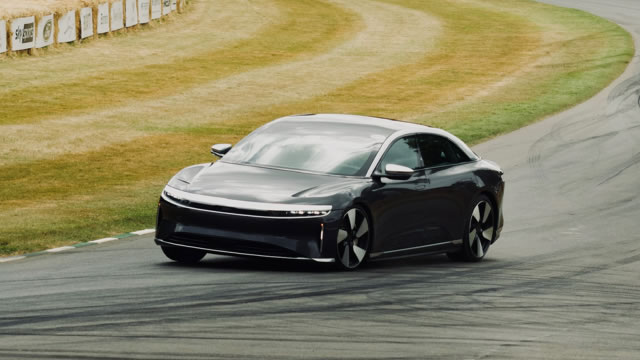
Lucid Motors (an EV startup founded by a former Tesla engineer) went public via a blockbuster SPAC deal in 2021, valuing the company at $24B. Saudi Arabia’s Public Investment Fund holds a majority stake, and the article frames Lucid as once a major Tesla rival. The piece is largely historical/contextual and does not cite new financial results or guidance.
Lucid should be treated less as a competitive EV franchise and more as a financing instrument with car-production optionality. The key market mechanism is dilution: a majority state sponsor lowers near-term default risk, but it also raises the probability that any rescue comes with concessions, new share issuance, or economics transferred away from public equity holders. That makes the stock sensitive to capital-markets perception rather than unit growth alone.
For TSLA, the second-order effect is mostly sentiment, not fundamentals. A weak high-end EV peer keeps pressure on the premium-valuation narrative across the sector, but it also indirectly supports Tesla by reinforcing scale advantages in cost, software, and manufacturing. In a risk-off tape, LCID is more exposed than TSLA because its equity story depends on access to cheap funding; the market will likely punish any sign of a shorter runway well before it affects delivery data.
The contrarian point is that a sovereign backstop is not the same as value creation. Consensus often assumes PIF ownership is bullish because it reduces bankruptcy risk; in practice, it can keep a weak asset alive long enough to soak up more capital. The real upside case is a clear strategic pivot over the next 6-18 months: either a credible restructuring that cuts burn meaningfully, or an explicit M&A/asset transaction that re-rates the equity as a call option on Saudi industrial policy rather than on EV execution.
AI-powered research, real-time alerts, and portfolio analytics for institutional investors.
Overall Sentiment
neutral
Sentiment Score
0.00
Ticker Sentiment
