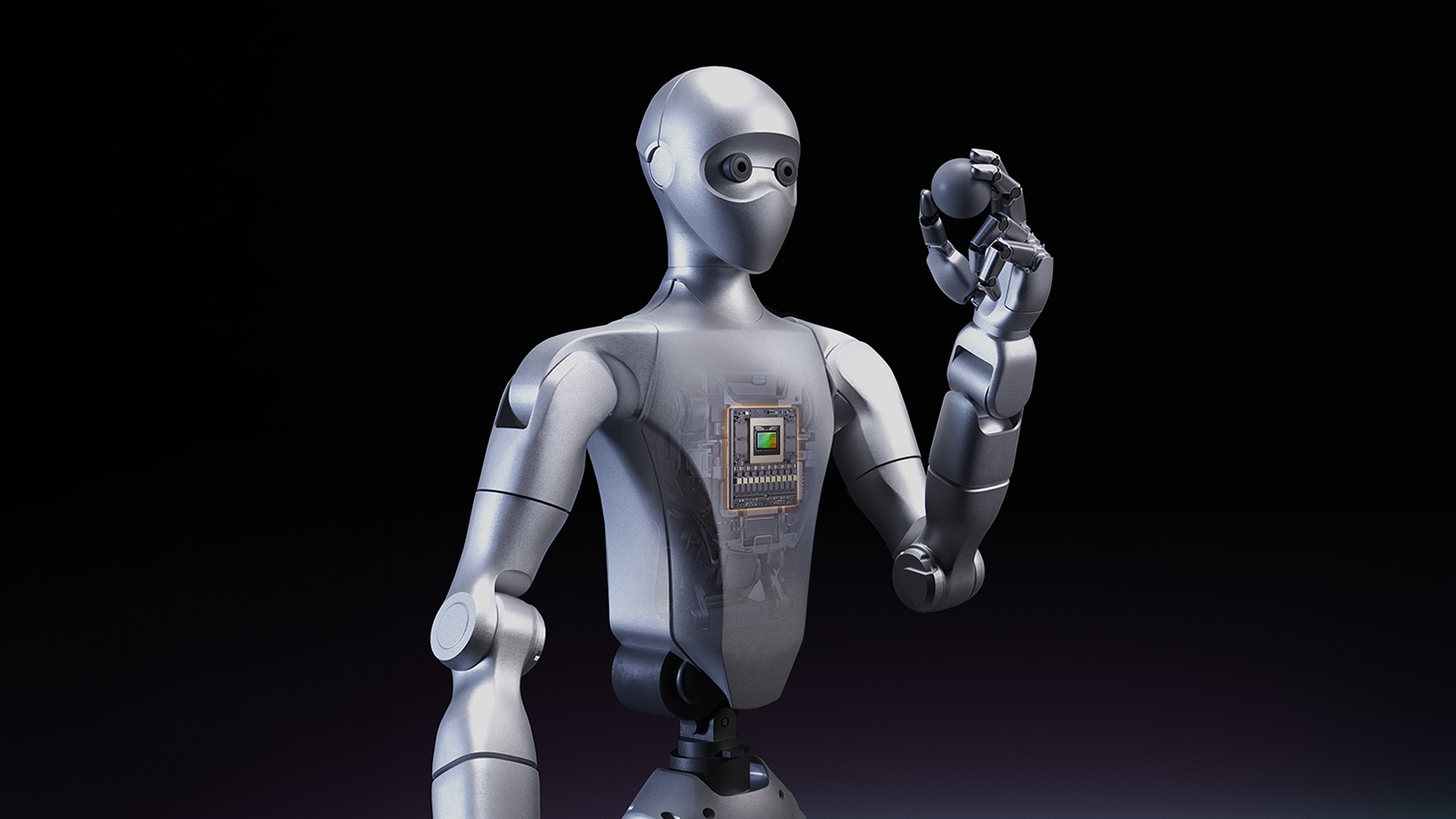
NVIDIA launched the Isaac GR00T Reference Humanoid Robot, an open humanoid reference design built on Jetson Thor and the Isaac GR00T software stack. The platform combines a Unitree H2 Plus chassis, Sharpa five-finger hands, multi-view sensing, and 2,070 FP4 teraflops of onboard AI compute to speed humanoid research and deployment. Leading institutions including Ai2, ETH Zurich, Stanford Robotics Center and UC San Diego will adopt the system, with availability from Unitree expected in late 2026.
This is less a product launch than an attempt to standardize the humanoid stack and pull the industry toward NVIDIA-defined infrastructure. The strategic win is not near-term robot revenue; it is making Jetson Thor, Isaac software, and training/eval workflows the default layer for every research lab and startup that wants to avoid reinventing the full pipeline. That creates a software-and-compute tollbooth effect analogous to what CUDA did in AI: once models, datasets, and deployment tooling accumulate around the stack, switching costs rise materially.
The second-order winner is the broader robotics ecosystem that can now move faster on data generation, simulation, and policy iteration without needing proprietary robot platforms. The losers are vertically integrated humanoid efforts that rely on closed stacks, because their moat narrows if academic and startup teams can prototype on an open reference design with comparable sensing and onboard inference. Over time, this may compress differentiation at the hardware layer and shift value toward whoever controls fleet data, reliability, and distribution in commercial deployments.
Near term, the market is likely to over-rotate on “humanoid TAM” optionality while underestimating the timing mismatch: research adoption can improve immediately, but meaningful unit economics are still years out. The key reversal risk is not technical failure but fragmentation—if multiple low-cost humanoid standards emerge, NVIDIA’s reference design becomes one option rather than the option. Another risk is that customers use the stack for development but deploy on cheaper or custom silicon later, limiting monetization capture.
The contrarian angle is that the announcement may be more bullish for robotics as a category than for incremental NVDA fundamentals in the next 12 months. The real value accrues if this becomes the standard training/deployment layer for fleets, not if a handful of labs publish better demos. Watch for early GitHub/Hugging Face traction and follow-on announcements from systems integrators; those are the signals that this is becoming an ecosystem, not a keynote feature.
AI-powered research, real-time alerts, and portfolio analytics for institutional investors.
Request DemoOverall Sentiment
moderately positive
Sentiment Score
0.62
Ticker Sentiment
