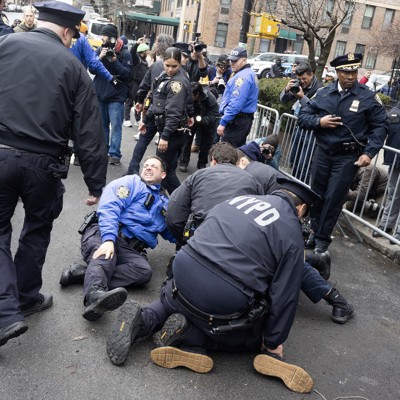
Two suspects, Emir Balat and Ibrahim Kayumi, were arrested and are being investigated as ISIS-inspired terrorism after deploying two improvised explosive devices containing TATP, nuts, bolts and screws at an anti-Muslim protest outside Gracie Mansion; neither device detonated and there were no reported injuries. The men will be prosecuted in Manhattan federal court and the NYPD is coordinating with the U.S. Attorney’s Office for the SDNY and the Joint Terrorism Task Force; three additional people were arrested for disorderly conduct and a separate suspicious device tested negative. The incident raises heightened domestic political and security risk in New York City—including targeted Islamophobic attacks on Mayor Mamdani—but is unlikely to have meaningful market-wide financial impact.
Market consequences will be diffuse but persistent: the most likely near-term market response is a brief risk-off knee in equities and modest bid for safe-havens (Treasuries, gold) lasting days; the financially meaningful effect is a reallocation inside municipal budgets toward surveillance, event security and counterterrorism line items that can lift small-cap vendors’ revenue by an incremental 3–8% over the next 12 months if procurement cycles accelerate. Expect procurement to favor recurring managed services (installation + monitoring contracts) over one-off capital equipment, which benefits companies with service-heavy revenue mixes and recurring revenue models.
Corporate winners will be narrow and operationally specific. Companies that sell city-scale physical security, monitoring and analytics (recurring service providers) and firms that can convert intelligence into operational tasking (analytics/AI contractors) stand to capture the bulk of incremental municipal spending; large defense primes will see only marginal upside because this is a city-level spending dynamic rather than an international defense procurement cycle. Insurance and event promoters are second-order losers: event insurers will reprice niche coverage (illustrative: short-tail event policies) and live events promoters/operators face higher NCI (non-cancellable insurance) costs and potential demand softening for large gatherings over several quarters.
Catalysts and timing: watch 30–90 day windows for city council budget amendments, RFP postings, and JTTF/public-private partnership announcements — these are the levered points that convert rhetoric into spend. Reversal scenarios include a lack of follow‑on incidents (which keeps budgets on status quo) or political pushback against expanded surveillance/regulatory hurdles that slow contract awards. Tail risks are asymmetric: a coordinated escalation would materially reprice municipal and corporate risk premiums across multiple years; conversely, a de‑escalation makes the theme a modest, sector‑specific reallocation rather than a market-wide shock.
AI-powered research, real-time alerts, and portfolio analytics for institutional investors.
Request DemoOverall Sentiment
strongly negative
Sentiment Score
-0.70
Trading should be tactical and modestly sized: favor option structures that cap downside while allowing capture of multi‑week to multi‑quarter procurement wins. Size bets for single events at 0.5–2% of portfolio; look for concrete procurement signals before scaling to full size.
