


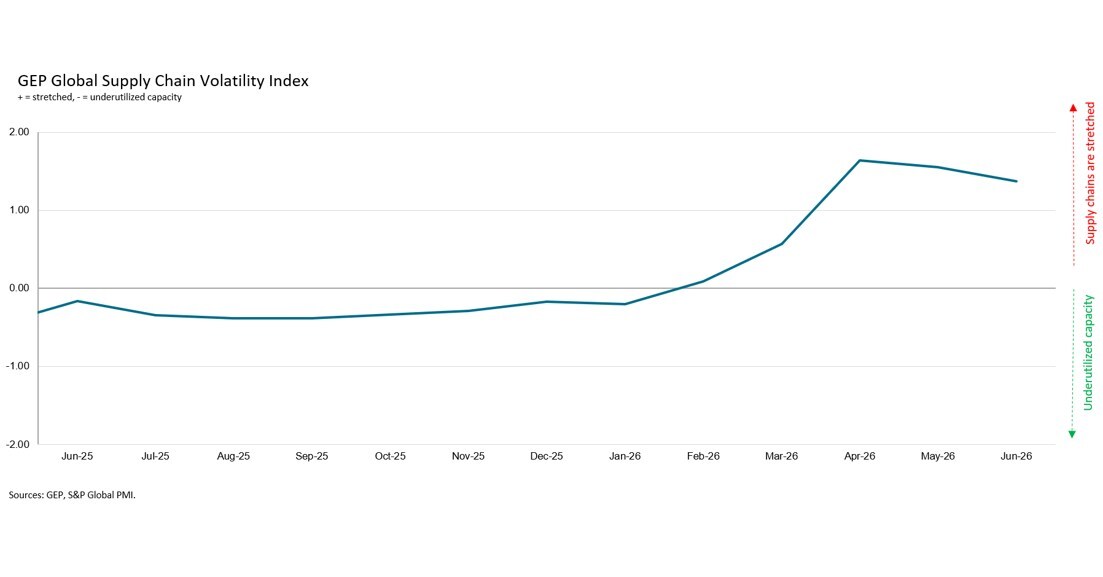
GEP’s Global Supply Chain Volatility Index stayed elevated in June, with global capacity still stretched as businesses built inventories amid persistent supply shortages. The index fell to 1.95 in Asia (from 2.96) and 1.17 in North America (from 1.69), but European and U.K. retrenchment was offset by inventory growth; safety stockpiling remained the highest since Jan 2023 and backlogs rose to the highest since late 2022. Despite lower oil prices and easing transportation costs, firms continued buying ahead, implying supply-chain disruptions could persist into at least Q3 amid uncertainty tied to the US-Iran ceasefire.
This reads less like a clean demand re-acceleration and more like a bullwhip: firms are pulling orders forward to self-insure against disruption, which boosts upstream volumes now but tends to leave a later inventory air pocket. The near-term winners are commodity and raw-material producers plus anyone with pricing power on scarce inputs; the losers are downstream manufacturers with thin gross margins and long lead-time exposure, especially in Europe where retrenchment signals a weaker absorption base for finished goods.
The second-order effect is working-capital inflation: higher buffer stocks mean more cash tied up in inventories and more revolver usage, which is supportive for C&I loan balances at banks but can become a credit issue if end-demand does not validate the stock build. That dynamic argues for sticky input-cost inflation even with softer energy/transport, which is bad for long-duration assets and helps keep real rates elevated into the next 1-3 months.
The contrarian point is that the market may overread 'strong purchasing' as healthy growth when it is really defensive buying. If the geopolitical backdrop stabilizes or lead times normalize, the unwind can be fast: procurement cools, commodity order books roll over, and the current inflation impulse reverses within a quarter. The key falsifier is a sharp drop in the next two monthly supply-chain prints or a clear rollover in PMI/ISM new orders and prices-paid components.
AI-powered research, real-time alerts, and portfolio analytics for institutional investors.
Overall Sentiment
mildly negative
Sentiment Score
-0.25
Ticker Sentiment
