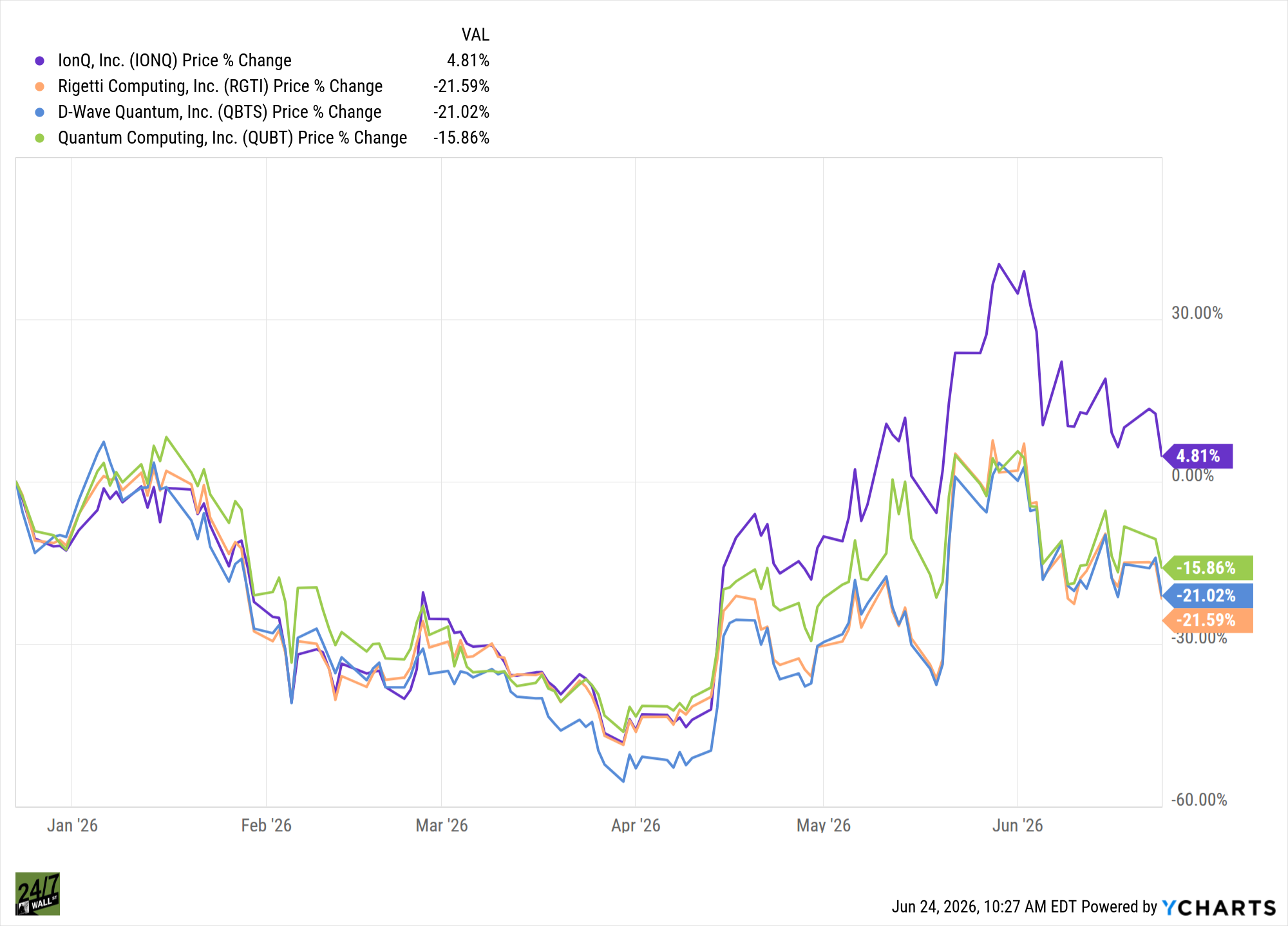
Quantum computing stocks are diverging, with IonQ outperforming over the past six months while D-Wave Quantum, Rigetti Computing, and Quantum Computing Inc. have moved lower. The article argues investors are shifting from broad sector enthusiasm to company-specific analysis centered on commercialization, revenue growth, customer adoption, and balance sheet strength. Larger infrastructure players such as Nvidia, Microsoft, Amazon, Alphabet, and IBM may benefit regardless of which quantum hardware architecture ultimately wins.
The market is moving from a single-beta “quantum” basket to a barbelled setup: a narrow set of names with credible funding runway, enterprise/government access, and platform optionality is starting to outrun the capital-intensive science projects. That matters because once dispersion begins in an emerging tech theme, passive thematic inflows usually get less effective and idiosyncratic short interest becomes more important; the loser cohort can de-rate faster than fundamentals because they lose the narrative multiple before they lose the technology. IonQ’s relative strength is less about architecture purity and more about being the first name the market can underwrite as a business rather than a lab.
The second-order winners are likely to be the infrastructure layer, not the hardware pure-plays. Cloud providers and compute enablers can monetize the “picks and shovels” phase for years through hybrid workflows, developer tooling, and ecosystem lock-in long before fault tolerance arrives; that creates a path where quantum adoption adds to cloud usage and AI/HPC workload mix even if standalone quantum revenue stays small. Nvidia is especially interesting because the catalyst is not direct quantum revenue, but expanded relevance of its software stack and accelerated-compute adjacency as customers experiment with quantum-classical orchestration.
The biggest risk to the current winner/loser split is not technical progress across the sector, but a sudden re-rate in patience. A credible enterprise deployment, major government contract, or a large strategic partnership from one of the laggards could trigger a sharp short-covering rally because positioning is likely skewed against the weaker names. Conversely, if macro risk appetite rolls over, the whole theme can de-gross quickly: long-duration, pre-profit quantum names tend to trade like high-beta call options on funding conditions, so they are vulnerable to even modest tightening in liquidity over the next 1-3 months.
The contrarian view is that the market may be underestimating how early we still are in the commercialization curve, which means the recent dispersion could be more about near-term sentiment than durable fundamental separation. In that scenario, shorting the weakest names outright is dangerous unless paired, because any incremental proof point can compress valuation gaps violently. The cleaner expression is to own the infrastructure beneficiaries and use the pure-plays as relative-value trades rather than directional macro bets.
AI-powered research, real-time alerts, and portfolio analytics for institutional investors.
Request DemoOverall Sentiment
neutral
Sentiment Score
0.15
Ticker Sentiment
