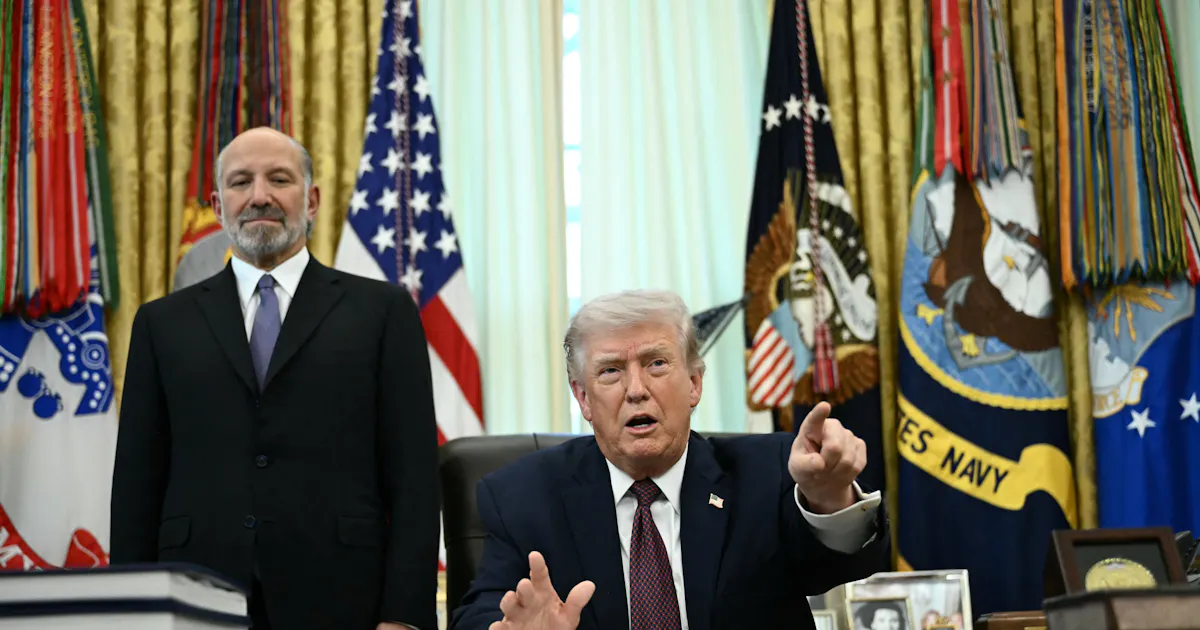
Trump administration officials reportedly explored banning voting machines in more than 50% of the country by labeling Dominion software a national security risk, with a plan to push hand-counting ballots. Commerce Secretary Howard Lutnick and others reportedly tried to find a legal justification, but the effort failed. The story is politically significant and could heighten pre-midterm election uncertainty, though it is unlikely to have direct market impact.
The market read-through is less about election administration and more about institutional friction premium. Any credible move toward centralized intervention in state-run voting infrastructure would raise the implied probability of legal challenges, state-level noncompliance, and procedural delays, which is toxic for near-dated political risk assets but not immediately monetizable in listed markets. The bigger second-order effect is on trust-sensitive sectors: cybersecurity vendors, election-services contractors, and public-sector IT integrators could face a higher political scrutiny discount even if they are not directly implicated, because procurement cycles lengthen when policy becomes adversarial.
The actionable macro implication is a higher tail-risk premium into the next 3-9 months, especially around the midterm calendar. Markets tend to underprice operational disruption risk until the last 60-90 days before a contested process; if the administration keeps pushing litigation or administrative workarounds, the volatility surface on assets tied to legislative outcomes should steepen. That argues for owning convexity rather than direction: event-volatility in market proxies tied to policy certainty should outperform outright beta if headlines intensify.
Contrarian view: the more extreme the proposal, the less likely durable implementation becomes, which means the base case may be headline noise rather than policy change. The real trade is not on whether machines are banned, but on whether repeated institutional conflict erodes confidence in the process enough to widen spreads in areas dependent on federal-state coordination. If court rulings or bipartisan pushback close off the path quickly, the opportunity fades fast and any fear premium likely mean-reverts within weeks.
AI-powered research, real-time alerts, and portfolio analytics for institutional investors.
Request DemoOverall Sentiment
moderately negative
Sentiment Score
-0.35
