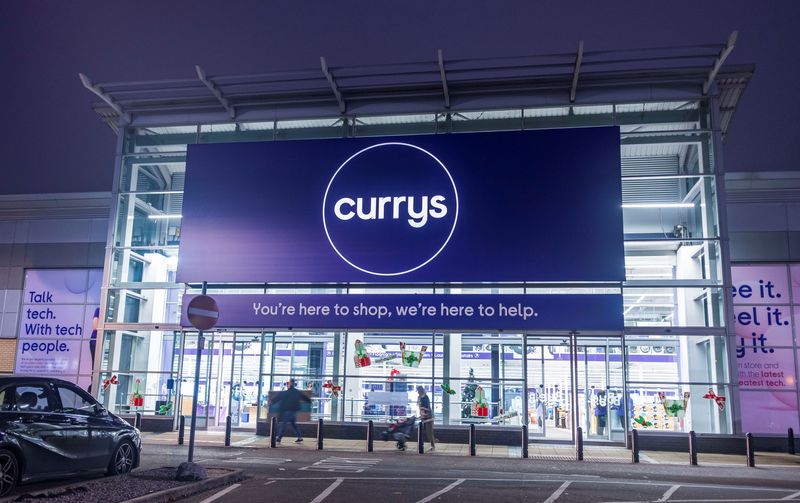
RBC Capital Markets upgraded Currys to outperform from sector perform and lifted its 12-month price target to 180p from 165p, citing stronger earnings momentum and a sharper balance sheet. RBC raised FY27 EPS by 5% and now models adjusted diluted EPS of 13.44p in FY26, 14.75p in FY27 and 16.40p in FY28, alongside a £50 million share buyback in FY27 and FY28. The brokerage also highlighted Currys’ 50bps UK market share gain, 25% credit adoption, and value in iD Mobile, while noting the stock still trades at 10.5x CY26 P/E.
This is less a one-day rerating story than a signal that the market is underpricing the durability of the earnings mix shift. The key second-order effect is that improving working capital, a cleaner balance sheet, and a profitable captive finance/telecom asset can push ROIC meaningfully above the core retail multiple, which should compress the discount versus other low-growth consumer names. If management sustains even mid-single-digit EPS growth while returning cash, the valuation argument changes from cyclical retail to cash compounder, which typically earns a 1-2 turn multiple premium over time.
The more interesting competitive angle is that Currys is quietly taking share where basket size and financing matter most: mobile, computing, and premium appliances. That pressures smaller specialists that lack scale in credit underwriting, supplier terms, or omnichannel fulfillment, and it also squeezes incumbent competitors that rely on promotions to defend share. The Nordic exposure matters because it gives a second earnings engine less tied to UK consumer confidence, so the stock becomes less sensitive to any single market and more sensitive to execution on margin expansion.
The main risk is that the balance-sheet story can reverse quickly if consumer credit quality weakens or if promotional intensity returns before cost savings fully flow through. The timeline matters: the stock can keep working over the next few months on buyback and earnings upgrades, but the longer-dated multiple expansion requires proof that share gains persist after rate cuts normalize and the easy cost benefits fade. A failure to monetize iD Mobile or a stalled buyback could expose the embedded sum-of-the-parts valuation as aspirational rather than realizable.
Consensus may be missing that the upside is not just higher EPS, but a structurally lower cost of equity if Currys is reclassified from distressed retail to asset-backed compounder. That reclassification can add more value than incremental earnings upgrades, because it affects both terminal multiples and financing terms. The market is likely still pricing in one more cyclical leg down; if that doesn’t materialize, the stock can re-rate faster than the operating forecast alone implies.
AI-powered research, real-time alerts, and portfolio analytics for institutional investors.
Request DemoOverall Sentiment
moderately positive
Sentiment Score
0.45
Ticker Sentiment
