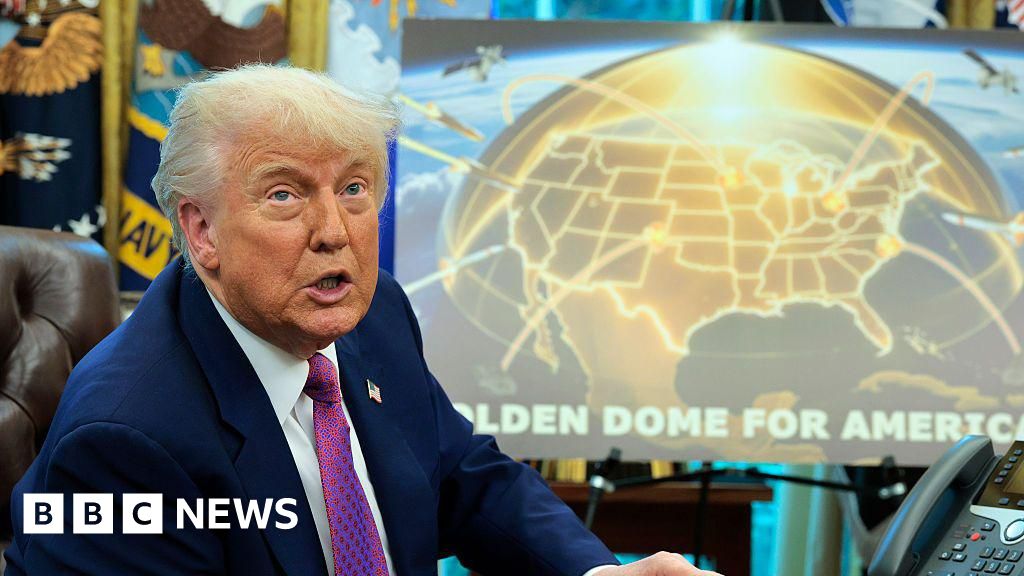
President Trump has proposed building a "Golden Dome," a next-generation missile defense system, to counter advanced threats like hypersonic weapons and orbital bombardment systems from nations like Russia and China. Experts agree on the necessity of upgrading missile defenses, but the project faces challenges due to its high cost, estimated to potentially reach hundreds of billions of dollars, and logistical complexity, including integrating land, sea, and space-based components; some analysts suggest Trump's proposed budget and timeline are unrealistic.
President Trump's proposal for a "Golden Dome" missile defense system aims to address perceived inadequacies in current US capabilities against advanced threats from peer adversaries like Russia and China, including hypersonic missiles and fractional orbital bombardment systems. While experts, such as Patrycja Bazylczyk from the Center for Strategic and International Studies, acknowledge the strategic necessity of bolstering defenses beyond existing systems—currently 44 ground-based interceptors primarily designed for limited ICBM threats—the "Golden Dome" project, still in its conceptual phase, faces substantial hurdles. Key concerns revolve around its immense projected cost, with Trump's $175 billion estimate significantly diverging from the Congressional Budget Office's projection of $542 billion over 20 years for space-based components alone, and expert opinions suggesting the total could be even higher. The logistical complexity of integrating multi-layered defenses across land, sea, and space, including novel space-based sensors, interceptors, and a currently non-existent overarching command and control system, is substantial. Defense analysts like Dr. Stacie Pettyjohn consider the administration's suggested completion timeline by the end of Trump's term as "unrealistic," warning that rapid development could escalate costs, risks, and potential system failures. Furthermore, the initiative has sparked geopolitical concerns, with China's foreign ministry cautioning about space militarization, though proponents argue it aims to enhance deterrence by altering adversaries' strategic calculus. The project's feasibility within the proposed parameters remains highly uncertain despite the acknowledged need to upgrade US defenses.
AI-powered research, real-time alerts, and portfolio analytics for institutional investors.
Request DemoOverall Sentiment
mixed
Sentiment Score
-0.10
