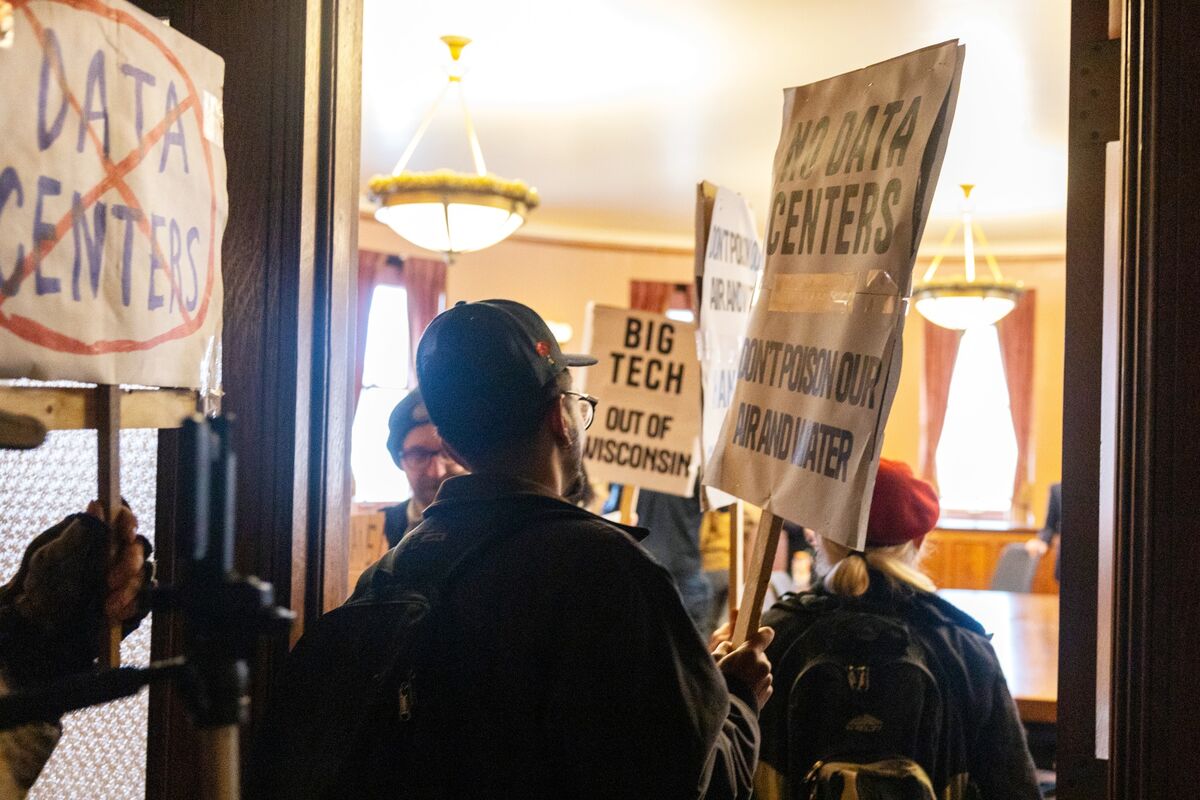
A Reuters/Ipsos June poll shows fewer than one-third of Americans approve of the rapid data-center buildout, with utility bills rising as much as 267% alongside the $725B construction rush. While GOP candidates are increasingly breaking with Trump’s pro-expansion stance ahead of midterms, the political pushback could slow permitting and increase regulatory risk for data-center expansion. Overall, near-term sentiment is cautious as energy-demand concerns and potential policy friction rise.
The market is likely underpricing how quickly this turns from a cultural issue into a permitting-and-rate-base issue. The immediate loser is any asset whose valuation assumes frictionless load growth in contested jurisdictions: data-center REITs, local utilities that were leaning on AI demand, and hyperscalers if they have to absorb higher mitigation costs for land, power interconnects, and community offsets. The second-order effect is a geographic split: projects in politically sensitive suburbs get delayed, while Texas/Southeast markets with faster approvals and cheaper power capture displaced capex.
Over 1-3 months, the trade is not about demand disappearing; it is about timing and option value. Political backlash raises the probability that utilities, governors, and local commissions demand more behind-the-meter generation, longer studies, and richer community concessions, which pushes out revenue recognition for developers but can support vendors that sell self-generation, backup power, switchgear, and grid hardening. That favors names like GEV, ETN, and parts of the distributed generation stack more than pure landlords.
Contrarian view: consensus is likely treating this as a noisy election-season headline, but the real mechanism is a higher cost of capital for siting in constrained power markets. If hyperscalers keep capex guides intact and local approvals in Virginia/Georgia/Texas keep clearing, the selloff should fade; if state PUCs and midterm candidates keep using utility bills as a wedge, the re-rating can last 6-18 months. The key falsifier is evidence that political pressure changes actual interconnection timelines, not just rhetoric.
AI-powered research, real-time alerts, and portfolio analytics for institutional investors.
Overall Sentiment
mildly negative
Sentiment Score
-0.20
