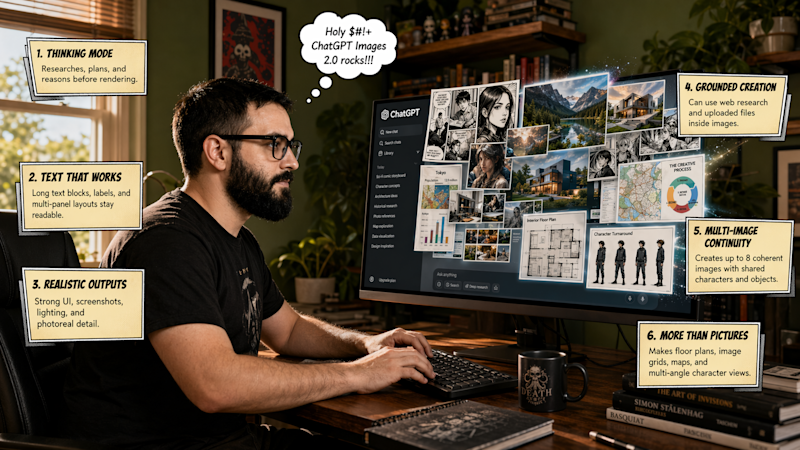
OpenAI is rolling out ChatGPT Images 2.0 and gpt-image-2, a major upgrade to its image-generation stack with reasoning, web search, better text rendering, multilingual support, and up to eight coherent images per prompt. The company is also deprecating GPT-Image-1.5 as the default while keeping it available on the API for legacy use, and pricing for the new API output is $30 per image and $10 per text output. The release strengthens OpenAI’s competitive position versus Google’s Nano Banana 2, but the immediate market impact is likely limited to AI/software sentiment rather than broad price movement.
This is a share-shift, not just a feature update. The key economic effect is that AI image generation moves up the value chain from novelty/asset creation toward workflow automation for marketing, education, product, and internal comms teams; that expands TAM but also commoditizes low-end design labor and generic creative SaaS. The immediate winner is OpenAI because it can monetize via higher-intent usage and defend retention with “thinking” workflows, while the second-order loser is any vendor whose differentiation depends on prompt-to-image quality alone.
For GOOGL, the risk is less about a single model gap and more about distribution: if OpenAI becomes the default for visual content inside ChatGPT, Google’s consumer surface loses another wedge into daily creation habits. That said, the market may be overestimating direct monetization from image generation; the bigger issue is brand lock-in and data flywheel effects that spill into chat, search-adjacent workflows, and enterprise productivity. The competitive response should come through bundling and workspace integration rather than pure model parity, which likely takes quarters, not weeks.
NYT is a cleaner indirect loser on the reputational/trust axis. As synthetic imagery gets more legible and convincing, publishers face higher costs for provenance, verification, and reader trust, while false visuals become cheaper to produce at scale. The near-term catalyst is not revenue displacement but increased friction around newsroom authentication, platform moderation, and legal risk from AI-generated deceptive content.
The contrarian view: the obvious bearish read on creative software may be too aggressive because better image generation increases total content volume faster than it cannibalizes incumbent tools. The more durable trade is on workflow owners that embed image creation inside paid collaboration stacks; the standalone image model providers can win usage, but the monetization accrues where the asset is deployed. Also, the safety/metadata layer may create a new compliance moat for enterprise adoption, reducing the odds of a pure race-to-the-bottom on price.
AI-powered research, real-time alerts, and portfolio analytics for institutional investors.
Request TrialOverall Sentiment
moderately positive
Sentiment Score
0.55
Ticker Sentiment
