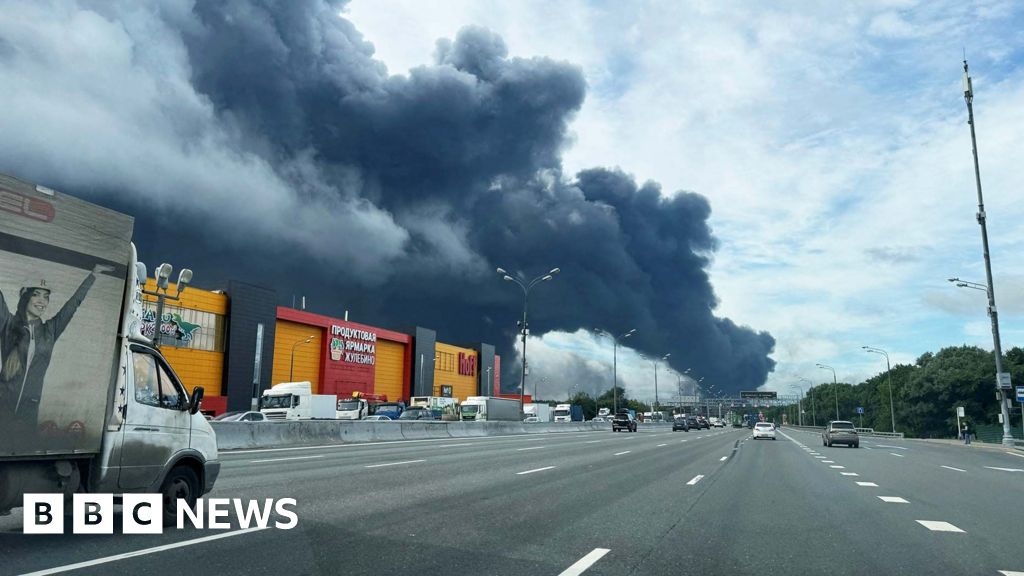
Russia reported one person killed, 17 wounded in the Moscow region, and temporary shutdowns at Moscow's four airports after Ukraine launched close to 200 drones and four cruise missiles in its largest attack since the start of the full-scale war. The Kapotnya refinery in south-east Moscow was hit for the third time in a month, sparking fires and smoke, while Russia said it intercepted nearly 1,000 drones and four missiles across the country in 24 hours. The attack adds to geopolitical escalation risk and highlights vulnerabilities in Russian energy infrastructure and air defenses.
The key market implication is not the tactical damage itself, but the signaling shift: Moscow’s air-defense umbrella is increasingly a de facto cost center rather than a deterrent. Repeated hits near the capital force Russia to allocate scarce interceptors, radar crews, and repair capex toward rear-area protection, which is a second-order drain on front-line persistence over the next 1-3 months. That matters because the marginal effect of each strike compounds: even low penetration rates can create disproportionate logistics disruption, insurance friction, and industrial downtime around the central transport belt.
Energy is the cleanest transmission channel. Attacks on refining nodes matter more than upstream production because they translate quickly into domestic product tightness, especially diesel and middle distillates, while Russia can more easily redirect crude than refined output. The bigger medium-term risk is not a crude price spike, but a widening export discount on Russian product and higher freight/war-risk premia for Black Sea and Baltic flows; that supports non-Russian refiners and tanker names more than broad oil beta if the market starts pricing intermittent processing outages rather than global supply loss.
The transportation/logistics angle is underappreciated: repeated airport closures and industrial-zone uncertainty around Moscow raise the probability of episodic congestion in domestic air and road freight, but the real consequence is higher operating slack and redundancy costs across Russian supply chains. For global investors, this is a risk-off catalyst for Europe-adjacent industrials and any company with Russia-facing receivables or distribution exposure. The contrarian view is that the market may overestimate immediate escalation risk while underestimating endurance: if Ukraine is using drones to impose economic fatigue rather than territorial change, volatility can stay elevated without producing a decisive oil shock.
The timeline that matters is days for headlines and 1-2 quarters for macro damage. If Russia responds with larger retaliatory salvos, the incremental impact on global energy prices could be muted unless actual export infrastructure is hit; otherwise, the trade is more about dispersion than direction. In that scenario, the winning posture is to own beneficiaries of disruption and avoid broad beta shorts that require a sustained commodity spike to pay.
AI-powered research, real-time alerts, and portfolio analytics for institutional investors.
Request DemoOverall Sentiment
strongly negative
Sentiment Score
-0.80
