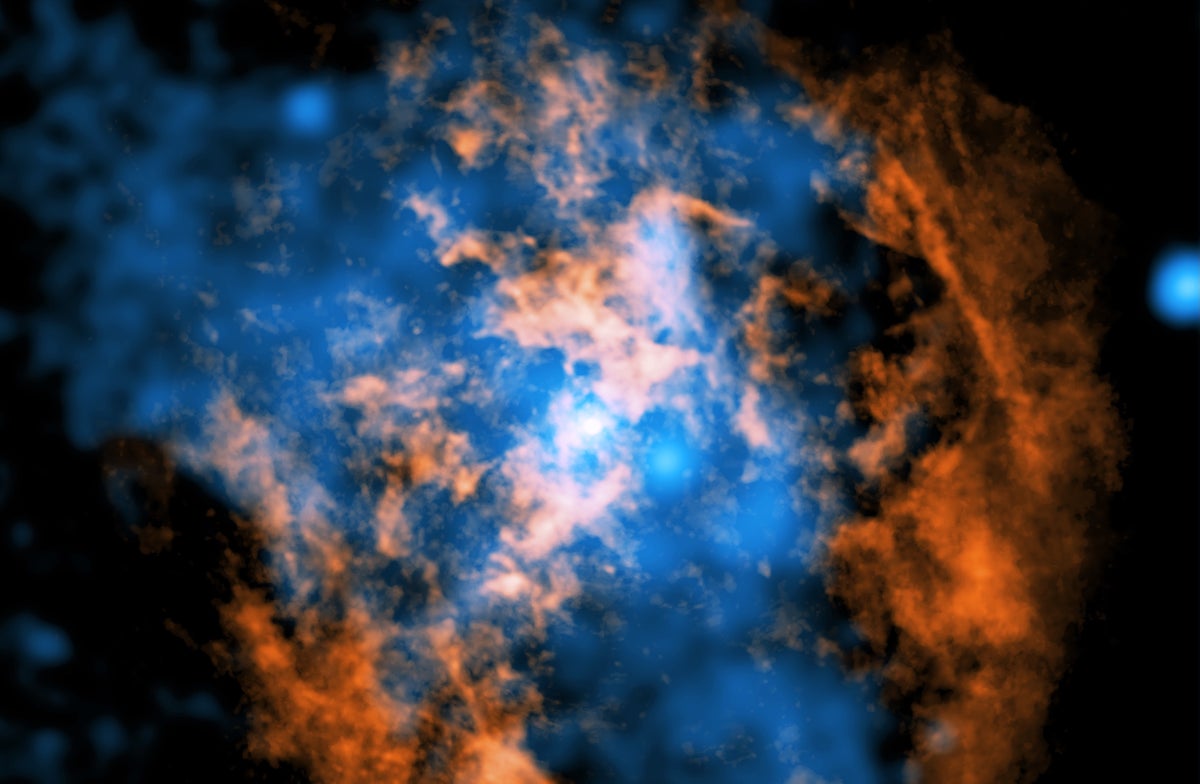
Scientists using ALMA and Chandra data have identified a previously unseen hot wind blowing from Sagittarius A*, the Milky Way’s central supermassive black hole, and found a cone-shaped cavity roughly 3 light-years long. The result suggests black holes can emit energy quietly through winds, not just violent outbursts, helping explain long-standing observations of our closest supermassive black hole. The finding is important for astrophysics research but has no direct market relevance.
The investable implication is not the astronomy itself but the signaling value: the result reduces uncertainty around how low-luminosity accretion behaves in the regime most relevant to SMBH feedback models. That matters because the market’s “AI/data center boom vs. physical constraints” debate increasingly depends on whether energy-losing processes can be treated as localized or whether they propagate into the surrounding medium; this study pushes toward the latter, which is a modest positive for firms exposed to precision instruments, adaptive optics, and radio/X-ray data pipelines rather than headline-grabbing space exploration names.
Second-order, the finding supports continued funding and procurement momentum for large observatories and multi-wavelength analysis stacks. The likely beneficiaries are the ecosystem that monetizes high-resolution sensing, calibration, and imaging software, because the scientific payoff here came from combining long-duration radio mapping with X-ray validation. That is a multi-year catalyst: agencies and universities will want more baseline observations, more cross-instrument fusion, and more compute-intensive reconstruction, which incrementally benefits selected hardware, storage, and workflow software vendors.
The contrarian angle is that this is not a near-term commercial step-change; the consensus may overestimate the revenue impact for pure-play space/astronomy beneficiaries. The real value accrues only if this shifts grant allocation or triggers a new instrument cycle, which is a 12-36 month process at best. In the meantime, the result mainly lowers skepticism around feedback-driven galaxy models, but it does little for broader market pricing unless it catalyzes a funding rerate in scientific instrumentation.
AI-powered research, real-time alerts, and portfolio analytics for institutional investors.
Request DemoOverall Sentiment
neutral
Sentiment Score
0.15
