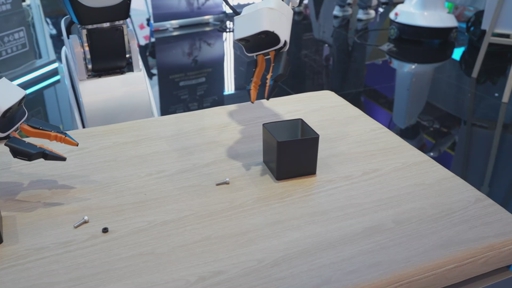
TARS won the SAIL Award at WAIC 2026 for its embodied-AI “AWE” base model, debuting AWE 3.5. The company claims ~2x task-execution efficiency vs Pi 0.5 and better performance on complex, multi-minute tasks with closed-loop interaction, alongside planned expansion of its real-world, human-aligned pretraining dataset from 1M to 10M hours by end-2026. It also showcased AWE-driven packaging/sorting demos plus a scaled automotive cable-harness production line using multiple A1 robots and the DexHand on an A1 robot for real-time perception/control demonstrations.
This is more credible as a commercialization milestone than a pure AI narrative catalyst. The key market mechanism is that embodied-AI vendors only re-rate if they can turn demo performance into repeatable deployment economics; awards and conference visibility mostly matter insofar as they lower partner-friction with factories and OEMs. Near term, the signal is strongest for industrial pilot pipelines in China, but the monetization path is still measured in months, not days.
Second-order winners are the picks-and-shovels around factory automation: machine-vision, servo, sensor, and edge-compute suppliers that get pulled into broader robot deployments even if TARS itself does not capture full economics. The losers are labor-arbitrage assembly models and legacy robot vendors that depend on deterministic task libraries; embodied models that generalize across objects and workflows threaten to compress their moat if reliability holds. The biggest question is not model quality but deployment density: if TARS can seed a few large plants, it could create a data flywheel that is hard for smaller peers to replicate.
The contrarian risk is that this remains a showcase-heavy category with weak conversion from technical promise to recurring revenue. A 10x dataset expansion sounds impressive, but the bottleneck is usually edge-case failure rates, integration costs, and customer willingness to tolerate downtime. If follow-on announcements do not include paid pilots, order backlog, or gross-margin evidence within 1-3 quarters, the stock can give back most of the conference premium quickly.
For a public-market expression, the cleaner trade is not chasing TARS outright but using it as a barometer for the robotics stack: long quality industrial automation names on weakness if you believe embodied AI adoption is real, or fade overextended robotics beta if subsequent ordering data disappoints. The thesis is falsified if TARS fails to convert this visibility into disclosed commercial deployments by the next earnings cycle.
AI-powered research, real-time alerts, and portfolio analytics for institutional investors.
Request DemoOverall Sentiment
mildly positive
Sentiment Score
0.25
Ticker Sentiment
