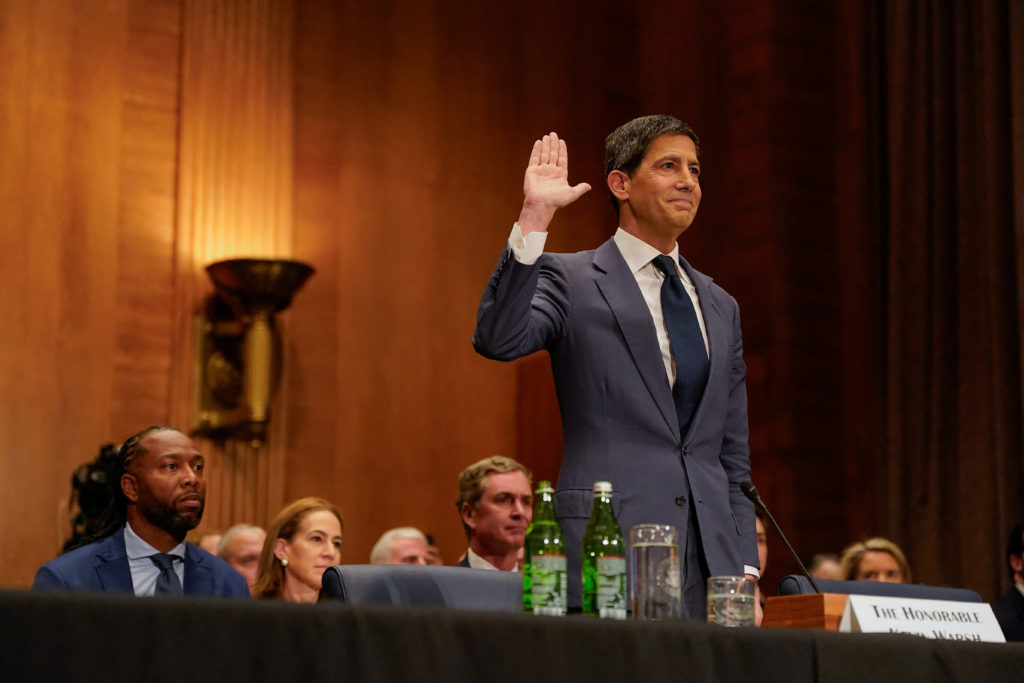
Fed chair nominee Kevin Warsh told senators he would protect Federal Reserve independence, but he faced intense scrutiny over whether he would follow President Trump’s push for lower interest rates and over his reported $100M+ personal wealth. Warsh signaled he is not prepared to cut rates quickly and pledged to sell financial assets, while lawmakers also raised concerns about an ongoing DOJ probe into Jerome Powell. The confirmation process remains stalled and could affect near-term expectations for Fed policy and leadership.
The market implication is not the nominee himself, but the signaling value of an overtly politicized Fed process. Even if Warsh never gets confirmed, the more important effect is a higher probability that rate-setting becomes a standing political fight, which widens term-premium risk and weakens the market’s confidence in the front-end policy path. That tends to matter more for 2Y–5Y yields than for the long end initially, because investors start pricing a less predictable reaction function rather than a cleaner growth/inflation forecast.
Second-order beneficiaries are duration-light, cash-generative cyclicals and financials with limited mark-to-market exposure, while the first losers are assets whose valuation depends on stable real rates and institutional credibility. Gold, inflation breakevens, and gold miners should see a bid on any escalation in Fed independence concerns, while long-duration software and other high-multiple equity cohorts remain vulnerable if the market re-rates the policy path higher or simply demands a larger risk premium. The more subtle knock-on is that a politicized Fed raises the odds of a steeper Fed-funds path volatility surface, which is bad for levered credit and rates vol sellers.
The contrarian view is that this may be more political theater than policy regime change in the near term. The Fed’s institutional inertia is high, and one chair cannot force rate cuts without committee support, so the real risk is not immediate easing but periodic headline shocks that keep risk premia elevated for months. That suggests the trade is less about directionality in the first move and more about owning convexity into a litigation/confirmation flare-up or a sudden attack on Fed independence.
Catalyst watch: confirmation timing, any DOJ decision on the Powell probe, and the next inflation release that constrains the Fed’s ability to validate political pressure. If markets begin to believe the White House may actually interfere with the chair transition, expect a sharp repricing in short-end rates, bank equity relative performance, and USD sentiment over a 1-3 month window.
AI-powered research, real-time alerts, and portfolio analytics for institutional investors.
Request DemoOverall Sentiment
neutral
Sentiment Score
-0.05
