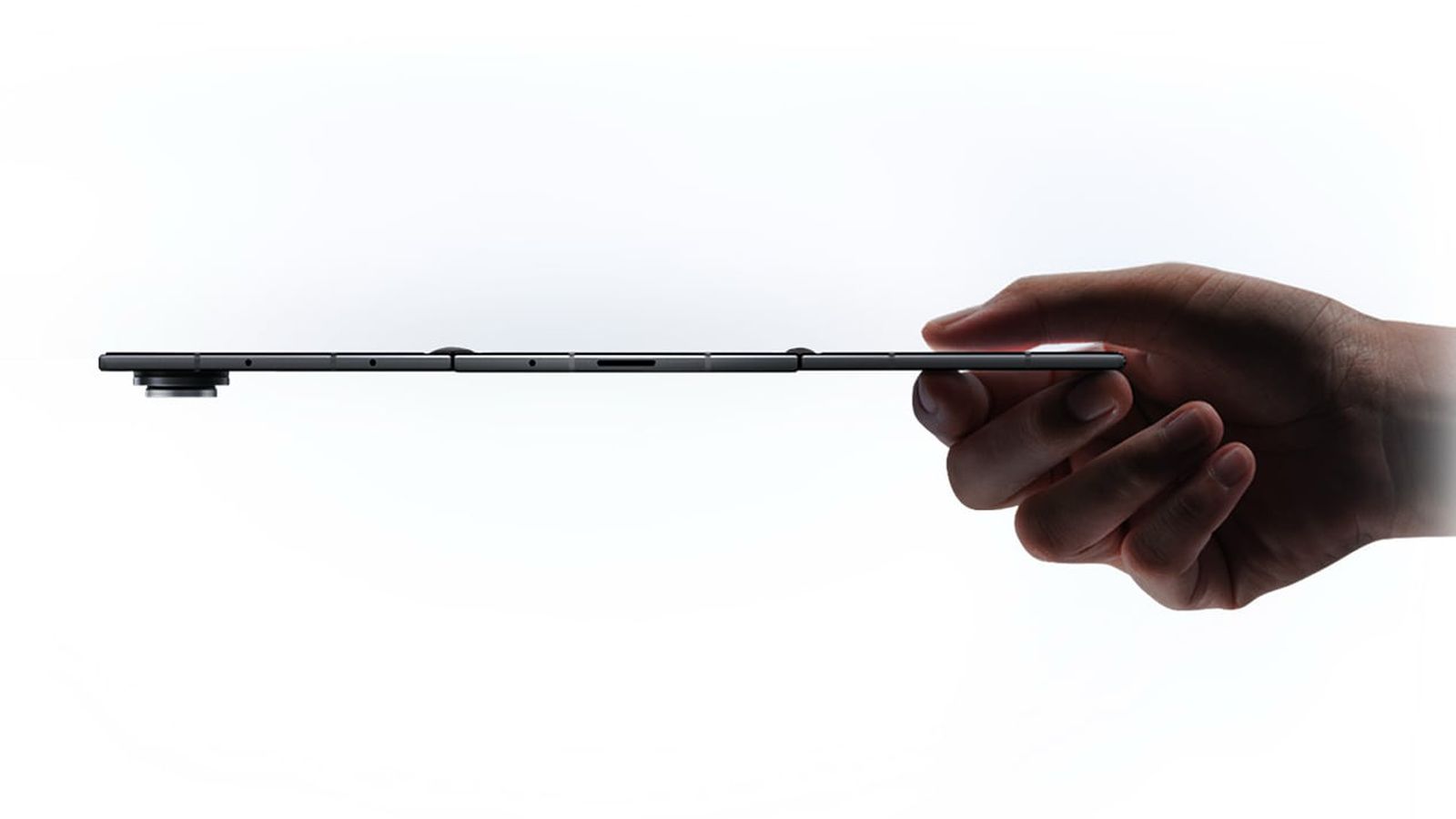
Samsung will discontinue the Galaxy Z TriFold globally after three months on sale, starting by ceasing sales in Korea and planning US discontinuation once inventory clears. The $2,899 tri-fold launched in Korea in December and the US in January, featuring a 10-inch unfolded display, 6.5-inch cover screen, a 5,600 mAh three-cell battery and a 200MP main camera. The rapid pullback — despite high-end specs and unique multi-app/tablet use cases — signals weak demand for the premium form factor and could modestly dent device revenues and product strategy credibility while posing limited broader market impact.
This cessation is a leading indicator of consumer risk-aversion to complex, high-priced form-factor experiments and will amplify two transmission mechanisms over the next 3-12 months: channel inventory markdowns and a bump in secondary-market supply. Retailers and carriers will use trade-in and promotional levers to clear premium inventory, which mechanically compresses ASPs across the top of the market and can shave smartphone gross margins by 1–3 percentage points near term as promotional intensity spreads beyond the failed SKU.
Supply-chain pain will concentrate on capitalized foldable-specific tooling and low-volume component lines (dual-hinge assemblies, three-panel flexible OLED processing) where utilization falls quickly; expect suppliers with >10% revenue tied to experimental foldable programs to face 2–6% revenue downward revisions and potential capex write-down discussions over the next two reporting cycles. Conversely, conventional component demand (standard OLED, CMOS sensors, mainstream battery cells) will see a transient reallocation, not destruction, creating a near-term funding gap but medium-term redeployment opportunity for suppliers that can scale back flex-specific capacity cheaply.
Strategically, Samsung is now under pressure to trade short-term margin discipline for brand protection: deeper discounts risk eroding premium positioning and making it harder to extract future foldable monopoly rents. This raises a binary catalyst set—either a controlled, gradual retreat with limited markdowns (low downside) or an aggressive clearance + marketing pivot that accelerates share loss in the super-premium segment (higher downside) — each resolvable within 90–180 days depending on inventory velocity and next-model cadence.
AI-powered research, real-time alerts, and portfolio analytics for institutional investors.
Request DemoOverall Sentiment
mildly negative
Sentiment Score
-0.25
