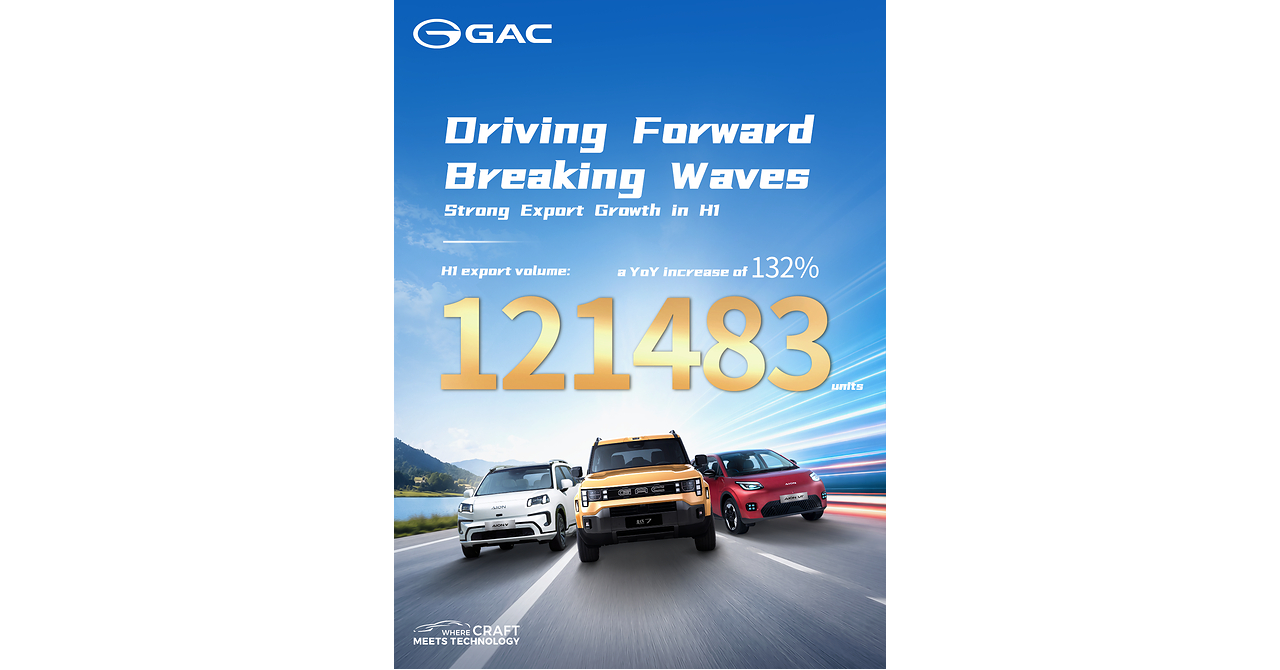
GAC International reports H1 2026 export volume of 121,483 units, nearly matching full-year 2025 exports and up 132% YoY. Retail and wholesale volumes abroad have doubled YoY, with notable momentum in Mexico (AION ES/AION UT in BEV top-10) and Hong Kong (cumulative EV market share >11% Jan–May after subsidy phase-out). Expansion continues in Europe (AION UT launched in Austria, operational rollout into UK/Spain) alongside strong regional rankings in the Middle East/Africa and higher-quality/residual-value awards in Kuwait/Thailand. Overall, the update is strongly growth-oriented and likely supportive for the stock, but it appears company-specific rather than market-wide.
The investable signal is not the unit growth itself; it is that GAC appears to be gaining share in markets where brand-building, service quality, and residual values matter more than home-market subsidy or fleet dumping. That is a better-quality form of export growth than the typical China EV story, and if sustained it should support mix, finance penetration, and dealer willingness to carry inventory abroad. The main beneficiaries are likely China’s better-capitalized exporters; the immediate losers are regional incumbents in low- to mid-priced EV/ICE segments, especially Japanese and Korean brands in ASEAN and Latin America, plus local distributors whose pricing discipline is now under pressure.
The second-order issue is margin durability. Overseas expansion usually looks flattering on units while hiding higher logistics, homologation, warranty, and marketing spend; if GAC is buying share, the market will eventually demand proof in gross margin and warranty accruals, not just export counts. If the reported residual-value strength is real, it lowers leasing friction and can accelerate fleet adoption; if it is promotional, that metric will deteriorate within 12-18 months as used-market supply normalizes.
Catalyst path: over the next 1-3 months, watch for evidence of channel stuffing, EU trade friction, or FX/shipping drag. The clean falsifier is any guidance that export growth is outpacing profit growth, or a recall/quality event that forces reserve buildup. In 6-18 months, the key question is whether this is a repeatable operating model or just a temporary window before tariffs, local-content rules, and price competition compress returns.
AI-powered research, real-time alerts, and portfolio analytics for institutional investors.
Request DemoOverall Sentiment
moderately positive
Sentiment Score
0.60
