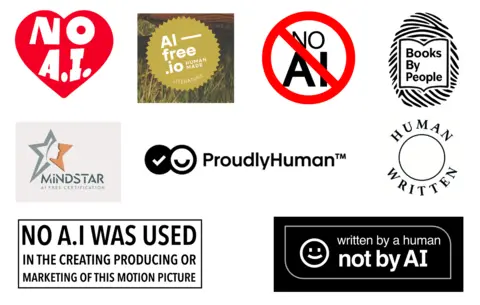
At least eight competing 'human-made' or 'AI-free' certification initiatives have emerged globally, from free downloadable icons to paid audited verification services. The proliferation of labels and lack of a single industry standard is creating consumer confusion and could support a modest premium for clearly 'human-made' content across media, publishing, music and advertising. For portfolios: minimal near-term market impact, but watch media/publishing firms for reputational differentiation, potential small revenue opportunities for certification providers, and regulatory/standards risks if a unified certification or regulation emerges.
Certification for “human-made” provenance creates a small, high-margin professional services market that incumbents in testing, inspection and certification (TIC) can monetize quickly. If even 1–2% of global content/retail spend is directed to paid verification over 24 months, that’s a $200m–$800m revenue pool that flows to a handful of accredited providers — enough to move EPS by mid-single digits for those winners. Win conditions favor firms with global lab networks, existing regulatory relationships and chain-of-custody tooling rather than boutique self‑certifiers.
A technical arms race is the second-order dynamic: detectors based on model fingerprints are brittle and will be evaded, forcing a shift toward provenance (watermarks, signed authoring metadata) and contractual audits. That structural shift benefits platform and software incumbents that can bake provenance into creative workflows, and increases demand for IP-rights insurance and legal services around allegedly mis‑labelled works. Expect productization of “lockstep” workflows where authorship is attested at point-of-creation — that is the durable moat, not the downloadable badge.
Regulatory or industry-standard convergence is the binary catalyst — if a national regulator or a major industry consortium mandates accredited verification within 12–36 months, adoption will concentrate rapidly and be highly profitable for accredited players. Conversely, persistent fragmentation and easy fraud will collapse consumer trust and render the label economically worthless; that tail risk rises if quick, cheap self-cert schemes scale before standards emerge. Monitor three lead indicators over the next 6–18 months: (1) procurement by large publishers/streamers of accredited audits, (2) incorporation of provenance tech in authoring tools, and (3) any legislative drafts referencing “AI‑origin” labelling.
AI-powered research, real-time alerts, and portfolio analytics for institutional investors.
Request DemoOverall Sentiment
neutral
Sentiment Score
0.00
