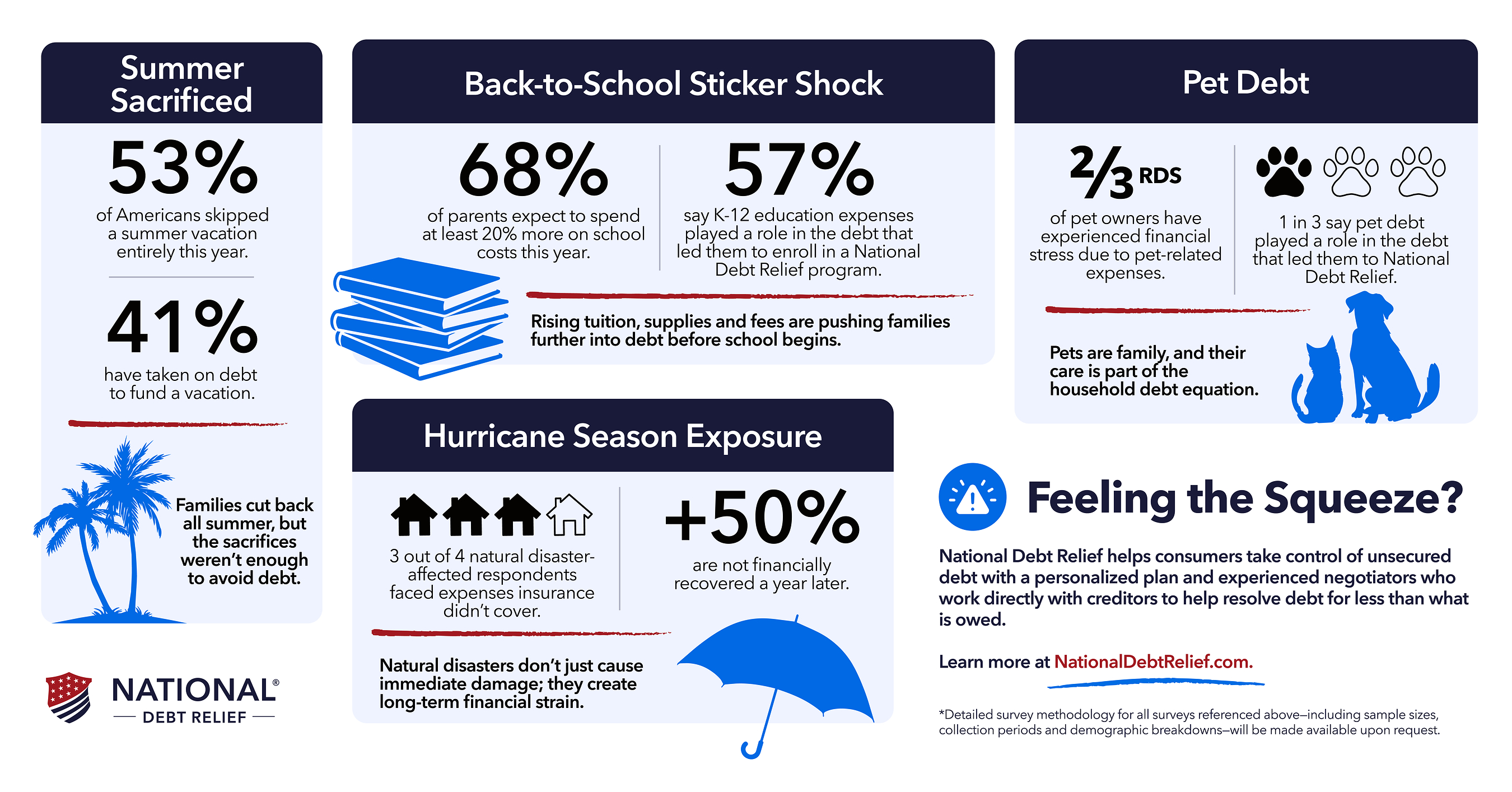
National Debt Relief surveys of U.S. consumers carrying unsecured debt point to worsening cash-flow stress heading into fall: 68% of parents who can estimate back-to-school spending expect to spend at least 20% more, while 21% plan to bridge the gap with credit cards or BNPL. Disaster exposure is also long-tailed—among clients affected, 54% are still struggling after one year and 75% faced expenses insurance didn’t cover (including one-fifth with $10,000+ costs). The data suggests fewer discretionary categories to cut, raising the risk of additional borrowing and sustaining demand for debt relief services.
This reads less like a broad consumer macro signal and more like a channel-shift warning: strained households do not disappear, they downgrade. That favors mass merchants, value grocers, and private-label suppliers while pressuring premium discretionary brands, because the first budget cuts are always on mix and basket size rather than outright unit collapse. The second-order effect is promotional intensity into back-to-school and holiday, which can compress gross margins for retailers that rely on higher-ticket discretionary traffic.
On credit, the near-term effect is volume-positive for card issuers and BNPL, but the quality of that volume is weak. If households are financing school, pet, or disaster-related gaps with revolving credit, the credit-loss impact will surface 60-120 days later, not immediately; that is more relevant for near-prime lenders and unsecured consumer ABS spreads than for banks with diversified income. The risk is that what looks like resilience in spending today is actually delayed deleveraging, which would show up in higher delinquency rates into year-end.
The contrarian point: this is a self-selected distressed cohort, so extrapolating it to the whole consumer is probably too bearish. The broader market may be overpricing a uniform slowdown when the real trade is dispersion — lower-income households under pressure, higher-income households still spending. If that is right, the right positioning is not a blanket short consumer, but a long trade-down / short premium mix.
The main falsifier is if wage growth, tax refunds, or easing gas/insurance costs materially offset these budget pressures over the next 1-3 months; in that case, the trade-down thesis fades and the signal becomes noise.
AI-powered research, real-time alerts, and portfolio analytics for institutional investors.
Request DemoOverall Sentiment
mildly negative
Sentiment Score
-0.28
