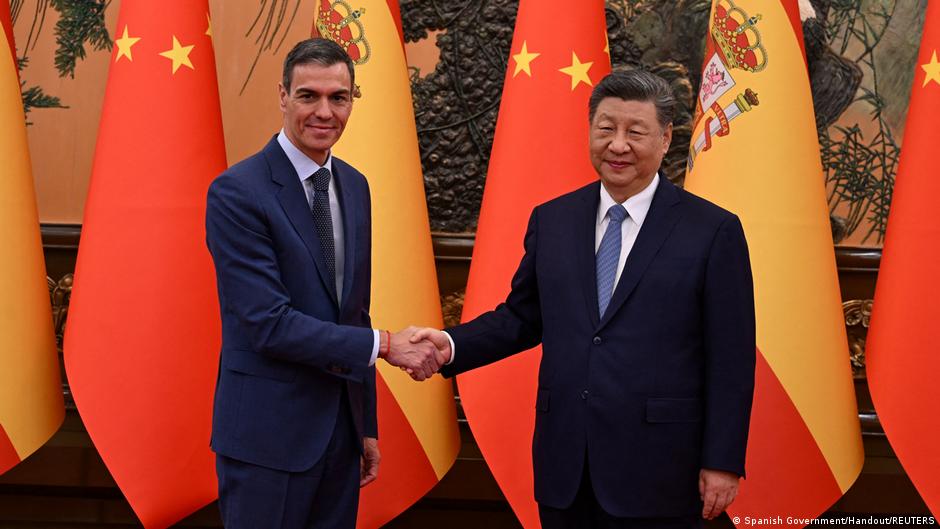
Spain and China agreed to expand market access for Spanish agricultural products and support Spanish transport and infrastructure, as PM Pedro Sanchez pushed to narrow a trade deficit that reached nearly $50 billion in 2025. Sanchez said China now accounts for 74% of Spain’s total trade deficit, calling the imbalance unsustainable, while also advocating closer China-EU ties amid strained relations with the U.S. The article is largely geopolitical and policy-oriented, with limited near-term market impact beyond Spain-related trade and infrastructure names.
The immediate market read is not “Spain-China détente” so much as a marginal re-routing of procurement power. The first beneficiaries are Spanish agri exporters, ports, rail, and project contractors tied to China-bound flows, but the bigger second-order effect is pressure on other EU exporters to concede price and local-content terms to defend access. That tends to help low-cost shippers, freight-forwarders, and industrials with Iberian exposure more than it helps broad Europe, because any incremental volume likely comes with thinner margins and longer working-capital cycles.
The more interesting setup is that this is a geopolitical hedge disguised as trade policy. If Madrid keeps positioning itself as China-friendly while Washington hardens its stance, the risk is not just diplomatic friction but a higher probability of procurement scrutiny, delayed defense cooperation, and episodic retaliation in sectors where the US still has leverage. That creates a medium-term tailwind for firms with non-US revenue mix and a headwind for Spain-linked businesses reliant on US military or federal contracting.
Consensus may be underestimating how limited the economic payoff is relative to the political cost. A bilateral trade fix can narrow one deficit channel, but it does little if the structural gap is driven by capital goods, machinery, and intermediate inputs; that means the improvement is likely slow and uneven over 6-18 months rather than a clean re-rating. In that regime, the tradeable expression is not a broad Spain beta bid, but selective long exposure to logistics/infrastructure names and short exposure to sectors most vulnerable to transatlantic policy spillovers or to Chinese bargaining power.
The contrarian risk is that if EU-wide officials see Spain extracting market access without giving up much, others may copy the playbook, improving China-facing sentiment across southern Europe. That could compress risk premiums in Iberian cyclicals, but only if Beijing follows through with measurable purchase commitments rather than symbolic MoUs. The base case remains headline-positive, earnings-neutral, with the real P&L impact showing up in contract timing and margin mix rather than in top-line surges.
AI-powered research, real-time alerts, and portfolio analytics for institutional investors.
Request TrialOverall Sentiment
neutral
Sentiment Score
0.05
