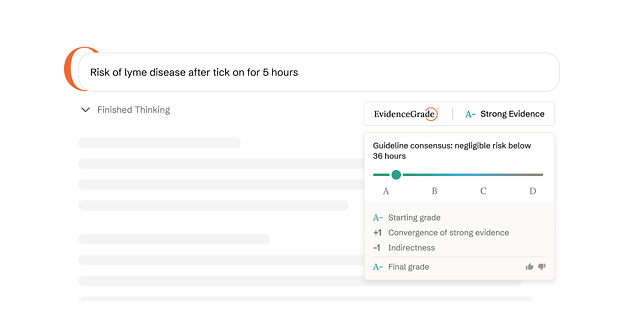
OpenEvidence launched EvidenceGrade, a new AI feature that grades and visualizes in real time the quality of the medical evidence cited in its answers, using the GRADE framework. The company positions it as improving transparency around study types (e.g., randomized blinded trials vs. observational studies) to help clinicians assess how safely evidence can be applied at the point of care. Market impact is likely limited in the near term, as this is a product/innovation update rather than a financial or regulatory catalyst.
This is not a CRMT catalyst; the ticker mapping looks misaligned, so the correct default is zero direct read-through. The underlying product update matters only if you own the trust layer in clinical workflow software: the market will increasingly reward AI tools that can prove provenance, not just answer speed. That shifts the valuation premium toward vendors with embedded distribution and defensibility around compliance, auditability, and clinical adoption, while compressing the multiple on generic “chat-with-medical-data” wrappers.
Near term, I would expect sentiment benefits to stay contained to private-company discourse unless a public peer can show physician conversion, retention, or revenue tied to evidence-quality features. The real second-order risk is liability: once users are told the evidence is graded, any missed grading error becomes more visible, raising product standards and slowing rollout cadence. Over 1-3 months, the catalyst is not the announcement itself but whether this becomes an enterprise purchasing criterion in health systems.
Contrarian view: the market may overvalue the feature as a moat. Better evidence labeling improves trust, but it is still a UX layer unless it changes reimbursement, workflow, or outcomes data. If physician usage remains high without measurable customer spend uplift, this is a brand-strengthener, not an earnings driver; if adoption depends on manual curation, scaling costs could rise faster than revenue.
AI-powered research, real-time alerts, and portfolio analytics for institutional investors.
Overall Sentiment
mildly positive
Sentiment Score
0.25
Ticker Sentiment
