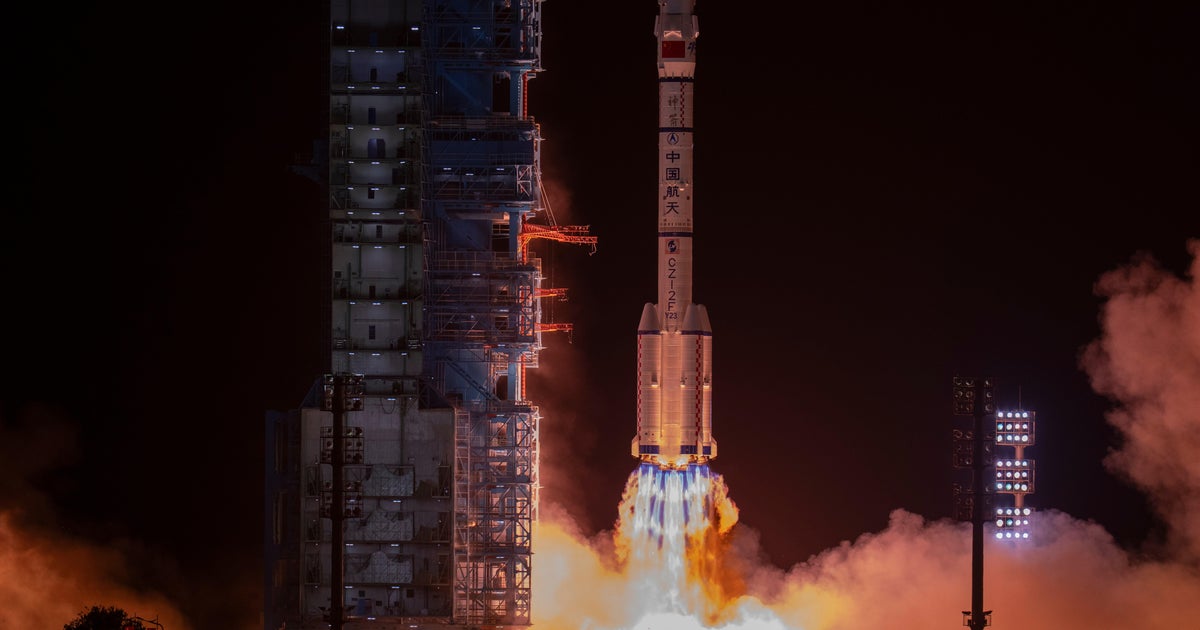
China successfully launched the Shenzhou 23 spacecraft carrying three astronauts to the Tiangong space station, including one crew member scheduled to remain in orbit for one year. The mission supports dozens of science and application projects and comes as China advances toward a crewed lunar landing target by 2030. The launch underscores continued momentum in China's space program, but it is largely a factual update with limited direct market impact.
China’s space cadence is becoming more industrial than symbolic: the marginal value is not the launch itself, but the learning curve embedded in repeated crew rotations, longer-duration physiology data, and operational redundancy. That matters because the strategic bottleneck for a lunar program is no longer boosters alone; it is closed-loop life support, autonomous rendezvous/docking, radiation hardening, and human-system reliability over 6-12 month intervals. In other words, the real option value is the conversion of state-directed R&D into exportable dual-use systems across avionics, materials, robotics, and ground-control software.
Second-order, this deepens the competitive split between companies tied to U.S.-aligned supply chains and those exposed to China’s procurement ecosystem. If Beijing keeps compressing its iteration cycle, expect incremental demand for domestic high-spec components, semiconductor test equipment, specialty sensors, and thermal management, while U.S. export controls become more about slowing subsystem accumulation than stopping headline milestones. The more interesting market effect is on defense primes and aerospace suppliers with China exposure: the narrative premium may rise for firms that can demonstrate non-China revenue mix and protected IP, while less differentiated hardware names could face valuation haircuts if investors price a longer technology bifurcation.
The contrarian point is that the biggest near-term risk is not technical failure but budget prioritization. Human spaceflight successes can mask opportunity cost: a tighter Chinese macro backdrop could force tradeoffs between prestige programs and nearer-term defense/industrial spending, limiting spillover to commercial adoption. For investors, the setup is better treated as a slow-burn geopolitics theme than a single-event catalyst; the window is months to years, not days, and the path likely includes intermittent setbacks that create better entry points than chasing momentum after each successful launch.
From a broader portfolio perspective, this is mildly supportive for the U.S. space/defense complex because it raises the strategic value of resilient launch, tracking, and counter-space capabilities. But the tradable edge is in identifying which contractors actually benefit from a more contested orbital environment versus those whose China revenue or joint-venture exposure makes them vulnerable to retaliation or licensing risk.
AI-powered research, real-time alerts, and portfolio analytics for institutional investors.
Request DemoOverall Sentiment
neutral
Sentiment Score
0.05
