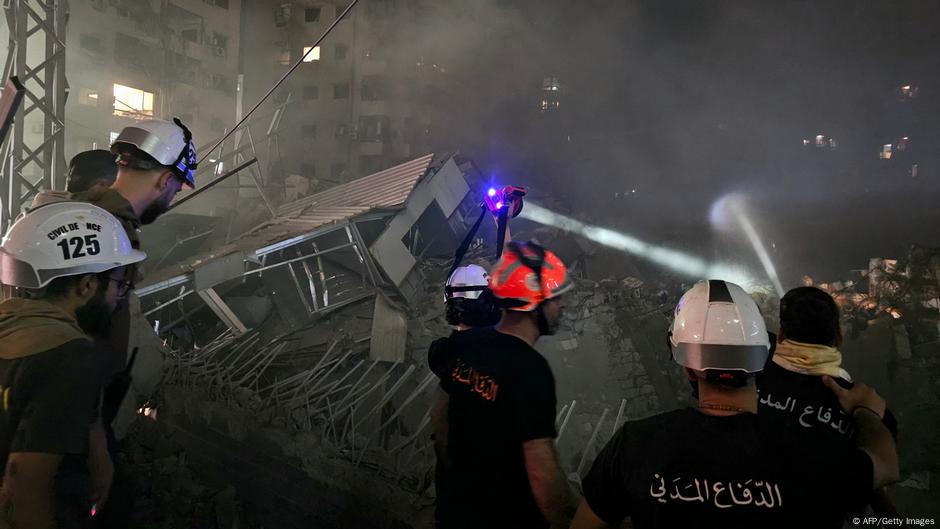
Israeli forces conducted airstrikes in Beirut's southern suburbs, targeting alleged Hezbollah drone production facilities, prompting condemnation from the Lebanese President who cited a violation of the November ceasefire agreement. Simultaneously, the US imposed sanctions on International Criminal Court judges in response to arrest warrants issued for Israeli Prime Minister Netanyahu and a former Defense Minister, a move criticized by Human Rights Watch as an attempt to deter accountability for potential war crimes in Gaza. Meanwhile, Gaza faces a severe humanitarian crisis during Eid al-Adha, with widespread food scarcity exacerbated by blocked aid shipments and the decimation of livestock.
The Middle East is experiencing a significant escalation in geopolitical tensions, marked by Israeli airstrikes on Beirut's southern suburbs targeting alleged Hezbollah drone production facilities. This action, which the Lebanese President condemned as a "flagrant violation" of the November ceasefire agreement, represents the fourth such bombing of Beirut since the truce and underscores the fragility of regional stability. Concurrently, the United States has imposed sanctions, including travel bans and asset freezes, on four International Criminal Court (ICC) judges following the issuance of arrest warrants related to Israeli officials. While the US framed this as a measure to protect its sovereignty and that of its allies, the ICC and Human Rights Watch have criticized the sanctions as an attempt to undermine judicial independence and deter accountability for potential war crimes. Amidst these developments, the humanitarian situation in Gaza has severely deteriorated, with the population facing a risk of famine as they mark Eid al-Adha. Israel's three-month blockade on food and aid, coupled with the decimation of 96% of livestock and 99% of poultry as reported by the UN, has resulted in acute food scarcity and astronomically high prices for available goods, profoundly impacting civilian life. Limited aid distribution has resumed at two sites by the Gaza Humanitarian Foundation, an organization reportedly backed by Israel and the US, following disruptions due to violence. The Israeli government has also admitted to "activating" some Palestinian clans opposed to Hamas in Gaza. The overall sentiment regarding these interconnected events is strongly negative, reflecting heightened conflict risk and severe humanitarian distress.
AI-powered research, real-time alerts, and portfolio analytics for institutional investors.
Request DemoOverall Sentiment
strongly negative
Sentiment Score
-0.70
