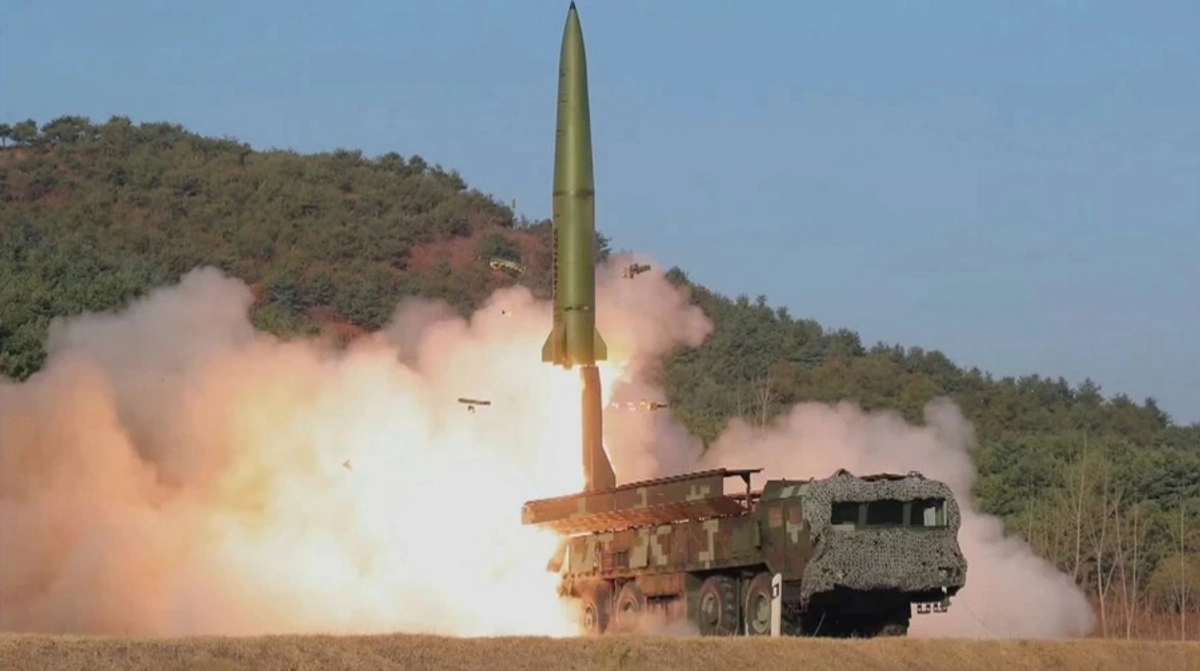
Ukraine's Defence Ministry says Russia used North Korean KN-23 and KN-24 ballistic missiles in strikes on Ukraine, with lab analysis of missile fragments recovered in Kharkiv in early January 2024 confirming North Korean design characteristics. The ministry said the missiles appear to be modified from an early Iskander design, contain sanctions-evading civilian components, and rely on outdated manufacturing methods, but remain difficult for air defenses to intercept. The findings will be used to support war-crimes investigations and inform sanctions policy.
The immediate market implication is not about the missiles themselves, but about the durability of sanctions leakage. If North Korea can source enough civilian-grade electronics, guidance components, and industrial inputs to sustain production, then the sanctions regime is proving more porous than headline rhetoric suggests; that raises the odds of broader secondary-sanctions enforcement across China-based brokers, maritime intermediaries, and gray-market machine-tool suppliers over the next 1-3 quarters.
The second-order effect is a modest but real tailwind for Western air defense, EW, and intercept capacity. Even imperfect ballistic systems force defenders to spend expensive interceptors, so the economic exchange rate favors suppliers of layered air defense, radar, command-and-control, and munitions replenishment. The relevant risk is not a one-day escalation spike, but a multi-month shift in procurement urgency as Ukraine and NATO planners treat low-cost exogenous missile supply as a persistent attrition channel rather than a temporary battlefield anomaly.
A less obvious angle is legal and compliance pressure on industrial firms with exposure to dual-use components, precision manufacturing, and shipping finance. Expect more audits of distributors of inertial sensors, power modules, machine tools, and thermal materials; that can create earnings risk for smaller cap industrial electronics firms with weak end-user screening even if they are not directly named in any enforcement actions. Conversely, the market may be underpricing the speed at which defense primes convert “threat evidence” into contract awards, especially for interceptor magazines and sensor fusion software.
Contrarian view: the headline can be read as escalation, but it also underscores North Korea’s technological constraints. That implies the near-term battlefield risk is lethality through volume, not step-change accuracy, which may cap the strategic impact unless production scales sharply. The bigger bull case is therefore not for war-related commodities, but for companies that monetize compliance tightening and defense replenishment over the next 6-18 months.
AI-powered research, real-time alerts, and portfolio analytics for institutional investors.
Request TrialOverall Sentiment
strongly negative
Sentiment Score
-0.55
