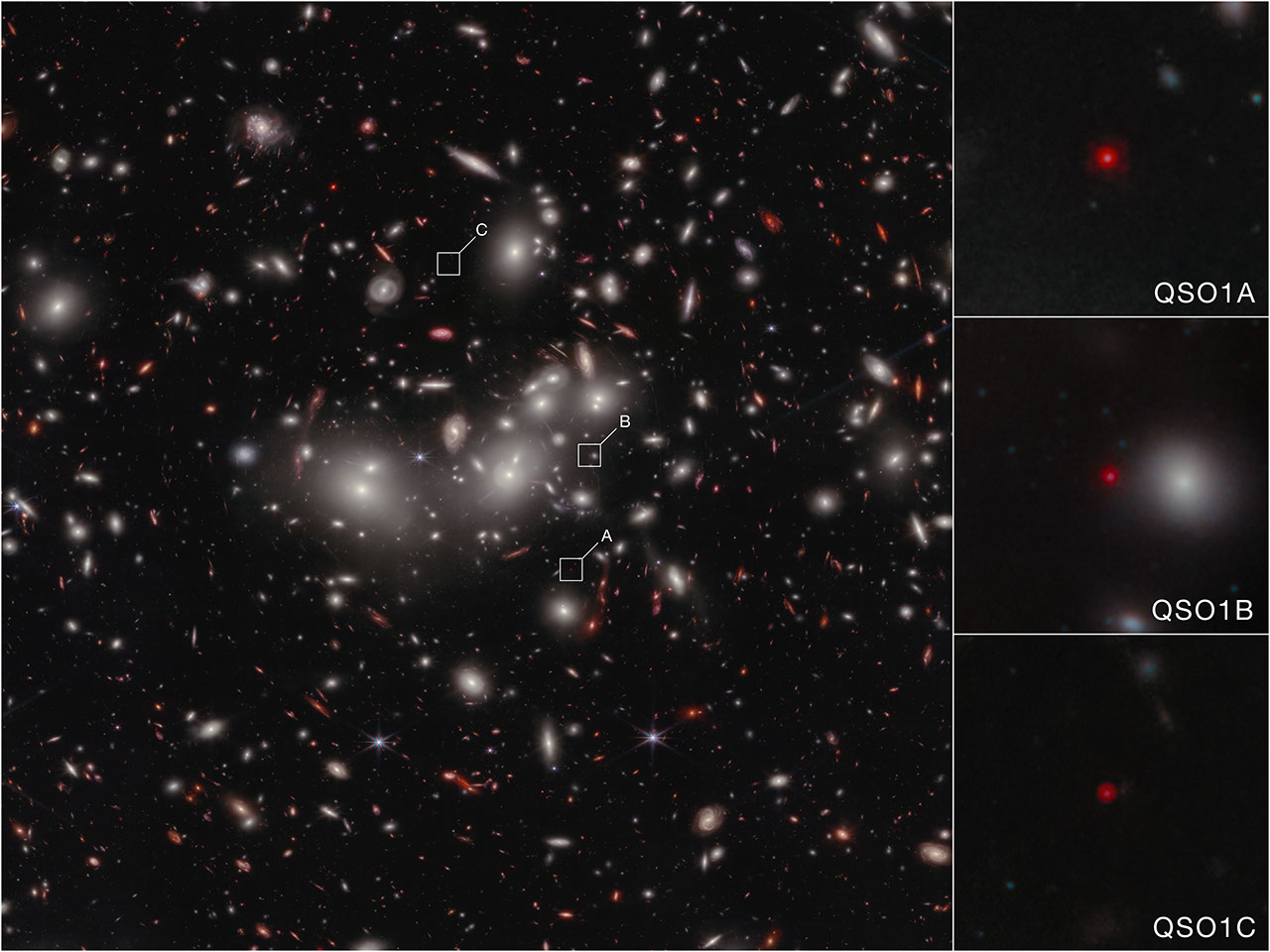
Researchers using NASA’s James Webb Space Telescope found direct evidence that the supermassive black hole in Abell2744-QSO1 is about 50 million solar masses and makes up at least two-thirds of the object’s total mass. The result suggests some black holes formed already massive, without requiring a prior stellar collapse phase or a substantial host galaxy. The article is scientifically important but has limited near-term market impact.
This is bigger than an astronomy headline: it raises the probability that the early-universe growth path for compact, high-redshift accreting systems is not linear but jump-started by rare heavy-seed formation. That matters for the “Little Red Dot” cohort because the investable implication is not one object, but a higher base rate that a subset of JWST discoveries are AGN-dominated systems with minimal stellar mass and unusually high accretion efficiency. The market implication is for continued upside in the entire high-redshift discovery stack — instruments, data-processing, and space-science contractors — because each new result increases the value of follow-on JWST time and successor mission funding. The second-order effect is that direct-collapse/primordial-black-hole hypotheses, if reinforced by more sample points, pull future capital toward high-contrast infrared spectroscopy and gravitational-lensing analytics rather than broad photometric surveys. That should benefit firms tied to detector performance, cryogenic systems, and space optics more than “headline NASA” exposure alone. It also creates optionality for AI-heavy astrophysics software vendors: the bottleneck becomes classification and modeling of a rapidly expanding object set, not just image capture. Contrarianly, the near-term reaction in the science ecosystem may be underdone because the result de-risks the most speculative interpretation of early black-hole masses rather than invalidating them. The bigger swing is not the single object, but the reduced skepticism around indirect mass estimates for early AGN, which should accelerate publication cadence over the next 6-18 months. The main reversal risk is that these systems turn out to be rarer or more selection-biased than they look; if so, the funding/ordering impulse for adjacent tools fades quickly.
AI-powered research, real-time alerts, and portfolio analytics for institutional investors.
Request DemoOverall Sentiment
mildly positive
Sentiment Score
0.20
