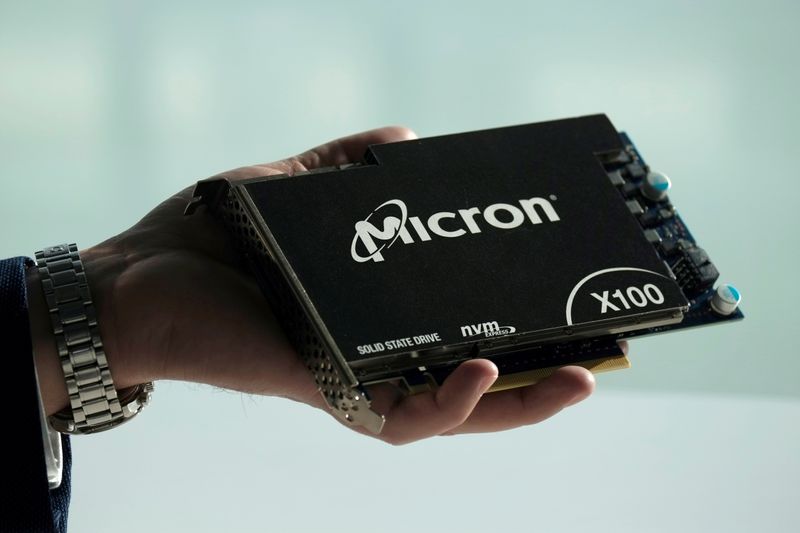
Micron Technology hit a $1 trillion market value for the first time as shares rose 18% to $886.6, with the rally tied to the ongoing AI boom. UBS sees more than 100% upside from current levels, reinforcing bullish sentiment around the memory chipmaker. The move is notable for MU and could support broader AI-related chip sentiment, but it is still primarily a single-stock catalyst.
The market is beginning to price Micron less like a cyclical memory vendor and more like a constrained AI infrastructure toll booth. That matters because the next leg of upside is unlikely to come from one-quarter earnings beats; it comes from a multi-quarter re-rating as HBM and server DRAM remain supply-tight and pricing power extends beyond the typical memory down-cycle. In that setup, the key second-order effect is that customers cannot easily diversify away from MU without slowing AI deployments, so procurement urgency can sustain margins longer than sell-side models usually assume.
The bigger winner may be the rest of the AI hardware stack that depends on bandwidth expansion, especially GPU/accelerator vendors and advanced packaging players. If memory remains the bottleneck, hyperscalers will have to keep over-ordering, which supports capex intensity and keeps the demand signal for compute hardware elevated even if software monetization lags. The loser set is more subtle: traditional PC/mobile memory end-markets become less relevant to the stock, but they still matter as a hidden downside if AI demand pauses and the market suddenly re-anchors MU to its old cyclicality.
Near term, the main risk is not a collapse in demand but a positioning reset. A 12% gap move on headline upside can easily invite profit-taking if guidance or channel commentary hints that expectations have outrun capacity additions; that risk is highest over the next 1-2 earnings prints, not over the next 1-2 days. Over months, the real reversal catalyst would be evidence that new wafer starts or competitor supply responses are catching up faster than anticipated, which would compress the duration of the AI memory scarcity trade.
The contrarian view is that the market may already be paying for a best-case HBM regime through 2026, so the asymmetry is shifting from multiple expansion to earnings delivery. That means the cleanest long is not an undifferentiated chase after a large gap-up, but exposure through structures that monetize continued strength while defining downside. If AI capex broadens but memory ASPs stabilize rather than inflect higher, MU can still work, but the next 100% upside case becomes much harder from here.
AI-powered research, real-time alerts, and portfolio analytics for institutional investors.
Request DemoOverall Sentiment
strongly positive
Sentiment Score
0.78
Ticker Sentiment
