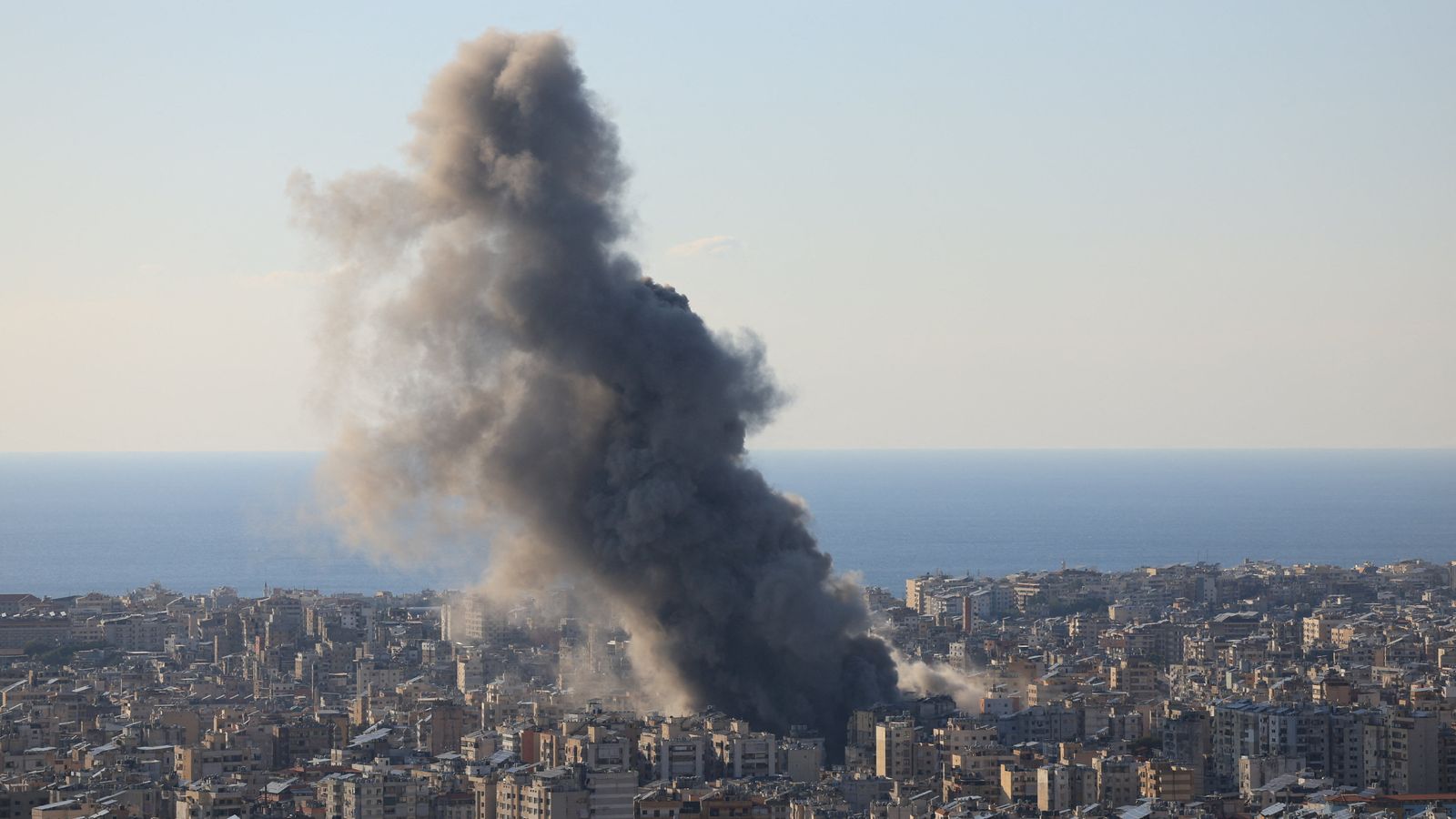
Hezbollah launched rockets and drones at a missile facility in northern Israel, saying it was retaliation for the assassination of Iran's supreme leader, prompting Israeli strikes across Beirut's Dahieh, the Bekaa Valley and southern villages and evacuation orders for 55 towns. The exchange follows a 13-month conflict and sustained Israeli operations into Lebanon despite a late-2024 ceasefire, and has provoked calls from Lebanese Prime Minister Nawaf Salam to curb Hezbollah's military role. The renewed hostilities increase regional political risk and downside pressure on risk assets sensitive to Middle East instability, particularly defense names, regional sovereign risk and commodity-linked exposures.
Market structure: Immediate winners are defense and security producers (Lockheed LMT, Raytheon RTX, Elbit ESLT) and safe‑havens/commodities (GLD, XLE/USO) as risk premia and insurance costs rise; losers are regional travel, tourism, Lebanese sovereigns and EM local‑currency debt with likely spread widening of +50–200bp in near term. Competitive dynamics favor large integrated prime contractors (LMT/RTX) that can ramp backlog and capture emergency orders; smaller regional suppliers and leisure/airline pricing power will compress as demand falls and war‑risk underwriting spikes. Supply/demand: energy tightness is the key transmission—a 3–6% shock to Brent from escalation (Brent +$5–$10) is plausible within 30 days, pressuring refined product & shipping rates and increasing freight/insurance costs. Cross‑asset: expect T‑bond rallies (2–5yr yields down 10–30bp), USD strength vs EM (EM FX down 3–8%), equity vol lift (VIX +30–80% intraday), and gold upside (GLD +5–10% on escalation).
Risk assessment: Tail risks include state‑level Iran retaliation or Israel wide ground offensive expanding to Syria (10–25% probability in 3 months) which would spike oil >$100 and equity drawdowns >10%; a narrower Hezbollah‑Israel attrition war is higher probability (30–50%) with protracted low‑intensity strikes. Time horizons: days—flight to safety, FX/credit moves; weeks–months—commodity repricing and defense reorder cadence; quarters—budget reallocations and sustained higher premiums for shipping/insurance. Hidden dependencies: insurance/war risk clauses in commodity trade, supply chain choke points via Red Sea/Suez routing, and Lebanon banking system contagion to Gulf deposits. Catalysts to accelerate: Iranian government responses, major energy‑infrastructure strike, or US military involvement; de‑escalation signals: confirmed prisoner exchange, UN mediation announcements within 7–21 days.
Trade implications: Direct plays: establish tactical longs in LMT (1–2% NAV) and RTX (1–2% NAV) for 3–9 months targeting 10–25% upside on defense reorders; buy GLD (2–3% NAV) and XLE (1–2% NAV) or 3‑month WTI call spreads if Brent >$90 triggers (buy USO call spread 3m 5–15% OTM). Pair trades: long LMT vs short UAL (1:1 notional) to capture defense upside vs travel compression; relative value long ESLT vs short EEM small‑cap EM basket for security exposure over EM cyclicals. Options: buy 1–3 month VIX call spread (long 30 / short 50) sized to cap loss at 0.5% NAV; buy 3‑month GLD 5% OTM calls as convexity to upside. Entry/exit: scale into positions over 48–72 hours; set stop losses: defense longs stop at -12%, energy longs stop if Brent falls below $75.
Contrarian angles: Consensus may overprice full regional war; historical parallels (2006 Lebanon war) show sharp local shocks but limited long‑run sovereign asset collapse—opportunity to buy select EM credits on 100–200bp dislocations. Underappreciated is reconstruction & telecom/infrastructure demand in Lebanon/Israel post‑conflict (6–24 months)—materials and engineering names could outperform once clarity emerges; consider watchlist (CRH, VMC equivalents) for 6–12 month entry if bidding processes announced. Reaction could be overdone in tourism/airlines—avoid permanent shorts unless escalation persists beyond 90 days. Key thresholds to monitor: Brent >$95, Israeli ground offensive declared, or Iran direct strikes—any two of three within 30 days should move portfolio from tactical hedges to defensive posture (>5% cash).
AI-powered research, real-time alerts, and portfolio analytics for institutional investors.
Request TrialOverall Sentiment
strongly negative
Sentiment Score
-0.60
