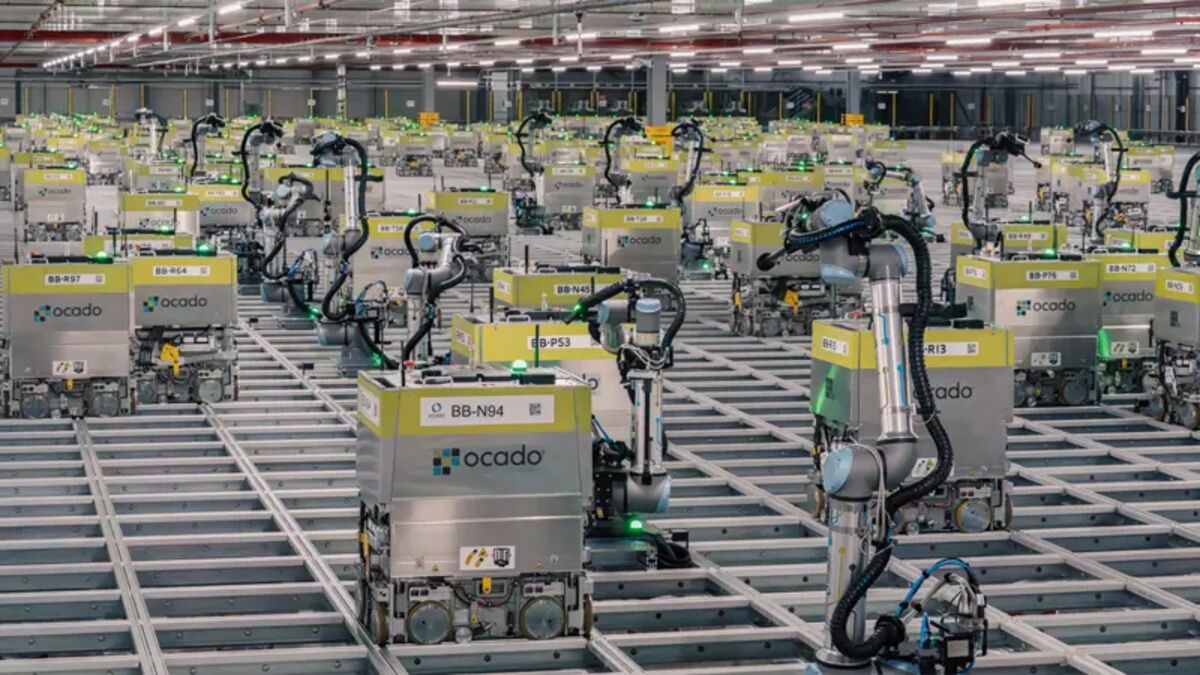
Kroger will pay Ocado Group a one-time $350 million cash payment after deciding to close three automated warehouses and scale back a wider rollout of Ocado’s fulfillment technology; Kroger is Ocado’s largest U.S. customer with eight fulfillment centers. The grocer is taking a $2.6 billion impairment as it shifts to completing online orders from its store network, a move that weakens the growth outlook for Ocado’s U.S. business despite the near-term cash infusion.
Market structure: Kroger’s $2.6bn impairment and rollback of automated warehouses is a clear win for omnichannel, store-based fulfillment players (WMT, COST) who avoid large automated-capex risk; Ocado gets a one‑time $350m cash cushion but loses scale in the US, reducing its prospective revenue runway by an estimated mid‑single digit % of previously disclosed Growth opportunities over 12–24 months. Pricing power shifts toward grocers with dense store footprints that can absorb ecommerce orders at lower incremental cost per order; automation vendors (hardware integrators) face lower immediate demand and margin compression.
Risk assessment: Near-term tail risks include additional Kroger closures or counterparty litigation with Ocado, causing >10% stock moves and 75–150bp credit spread widening over days–weeks; medium-term (3–12 months) execution risk around Kroger’s ability to cut online unit cost by >10–15% to offset the impairment; long-term (12–36 months) strategic risk is structural under-adoption of fully automated dark stores, pressuring valuations of automation IP/acquirers. Hidden dependencies: Ocado’s value is more IP/licensing than US real estate — adverse decisions could accelerate M&A or write‑downs.
Trade implications: Tactical short bias to KR equity/credit is warranted near-term; favor long WMT/COST vs short KR as a 3–12 month pair trade to capture margin reversion in omnichannel. Use defined-risk options (3‑month put spreads on KR) to monetize short-term downside while sizing credit protection (single-name CDS) if 2Y–5Y spreads widen >75bp. Reduce exposure to pure-play automation hardware stocks and redeploy into grocery retailers with dense store counts and positive free cash flow.
Contrarian angle: The market may over-penalize Ocado’s equity — $350m materially extends cash runway and preserves IP optionality; a disciplined 6–12 month watch could reveal acquisition interest at distressed multiples. Conversely, the knee‑jerk short on Kroger could be overdone if store-based fulfillment reduces online unit costs by >10% within 12–18 months and management demonstrates margin improvement on the next two quarters.
AI-powered research, real-time alerts, and portfolio analytics for institutional investors.
Request DemoOverall Sentiment
moderately negative
Sentiment Score
-0.30
Ticker Sentiment
