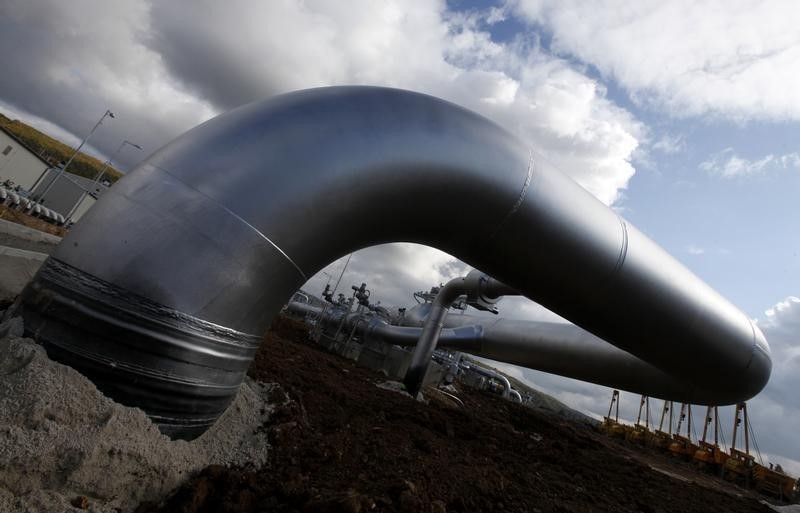
European wholesale gas prices rose 4.2% to 45.40 euros/MWh as colder weather forecasts and renewed U.S.-Iran tensions pressured sentiment. Iran seized two ships in the Strait of Hormuz, amplifying geopolitical risk in a key energy shipping lane, while EU gas remains about 39% below its March 19 peak of 74 euros/MWh.
The market is starting to price a classic supply-shock setup, but the more important second-order effect is cross-asset dispersion: energy input costs rise immediately, while the beneficiaries are the assets with convexity to scarcity and volatility, not necessarily the broad energy complex. European gas is the cleaner expression than crude because it has less global slack and a more fragile regional marginal buyer; that makes the move more likely to persist on even modest weather or shipping disruptions, especially if Hormuz risk keeps freight and insurance costs elevated.
For equities, the immediate read-through is negative for high energy-intensity sectors and anything with stretched margins, while the most durable winners are firms with direct exposure to power demand, grid bottlenecks, and data-center infrastructure. The AI hardware names in the tape can still catch a relative bid if investors continue to rotate into secular growth, but higher gas/oil prices are a tax on consumer discretionary and on any earnings model that assumes benign input costs through Q2-Q3. The second-order bear case is that this becomes a slow-burn inflation impulse rather than a one-day headline, which would compress multiples just as cyclicals were trying to stabilize.
The contrarian risk is that the move in gas and oil can overshoot before physical shortages actually show up, then mean-revert if diplomatic signaling improves or strategic supply is released. But until shipping risk in the Strait is resolved, the market is likely to pay up for optionality: long volatility in energy, short margin-sensitive consumers, and selective longs in infrastructure beneficiaries. Tesla is a nuanced tell here — higher fuel prices help the medium-term EV substitution thesis, but if the shock is primarily inflationary and risk-off, the near-term effect is multiple compression, not fundamental acceleration.
The cleanest setup is to trade the divergence between Europe-facing gas exposure and broad industrial/consumer beta, rather than chase the headline move in crude itself. Over a 2-6 week horizon, this is more about earnings revisions than spot prices: the losers are the names with no pricing power and the winners are the ones with hard-to-replicate infrastructure, storage, or power optionality.
AI-powered research, real-time alerts, and portfolio analytics for institutional investors.
Request TrialOverall Sentiment
mildly negative
Sentiment Score
-0.28
Ticker Sentiment
