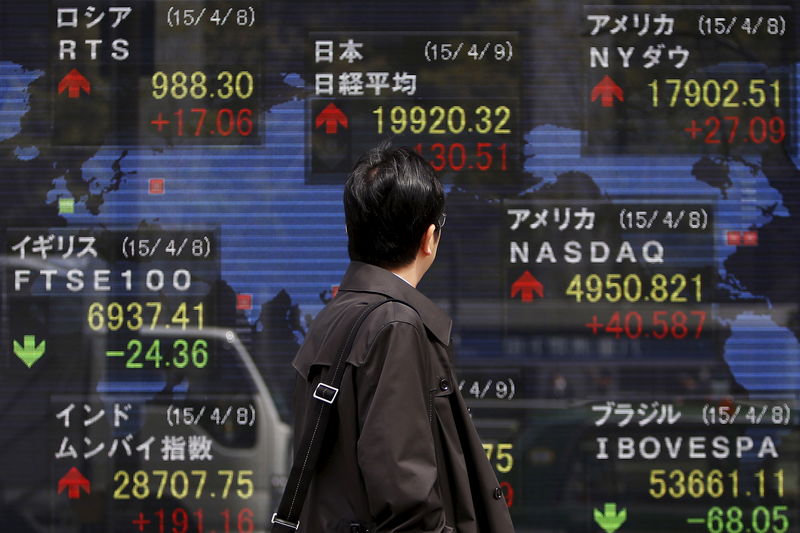
Asian equities reversed early gains as persistent U.S.-Iran tensions and Strait of Hormuz supply risks drove a risk-off move, with oil holding above $100 per barrel. Japan’s Nikkei 225 fell 1.1% after earlier topping 60,000, while South Korea’s KOSPI slipped 0.5% despite SK Hynix reporting a more than five-fold jump in first-quarter operating profit and Samsung rising 2.3%. China, Hong Kong, Australia, Singapore, and India futures also declined, underscoring broad regional caution despite strong tech earnings and better-than-expected South Korean GDP growth of 1.7% quarter-on-quarter and about 3.6% year-on-year.
The market is starting to price a classic geopolitics-versus-growth tug of war, but the more important second-order effect is on positioning: after a strong tech-led run, the marginal buyer is now highly sensitive to any exogenous oil shock that can force a de-risking across crowded momentum trades. That makes the near-term risk less about a broad equity correction and more about factor rotation out of high-duration tech, semis, and cyclicals into cash-generative defensives and energy-linked exposures.
For AI supply chains, the obvious read is that higher power and freight costs are noise; the real issue is whether geopolitical stress slows the pace of data-center capex by tightening enterprise risk budgets. That said, the strongest companies in the AI stack can still absorb input inflation if demand remains intact, so the relative loser is not the AI theme itself but the lower-quality beneficiaries with weaker pricing power and bigger reliance on multiple expansion. In that frame, the post-earnings enthusiasm in memory and GPU adjacencies may be vulnerable if investors start demanding proof of demand durability rather than extrapolation.
The oil shock risk is asymmetric over days, not months: any additional disruption in Strait traffic can force a rapid reassessment of earnings estimates, inflation breakevens, and rate-cut timing. That creates a narrow but attractive window to express a hedge against equity beta through energy or volatility rather than outright index shorts. The contrarian point is that a ceasefire extension may already be enough to cap the panic premium unless there is clear evidence of sustained supply loss; if so, the current move may be more about positioning unwind than a lasting regime shift.
AI-powered research, real-time alerts, and portfolio analytics for institutional investors.
Request TrialOverall Sentiment
moderately negative
Sentiment Score
-0.35
Ticker Sentiment
