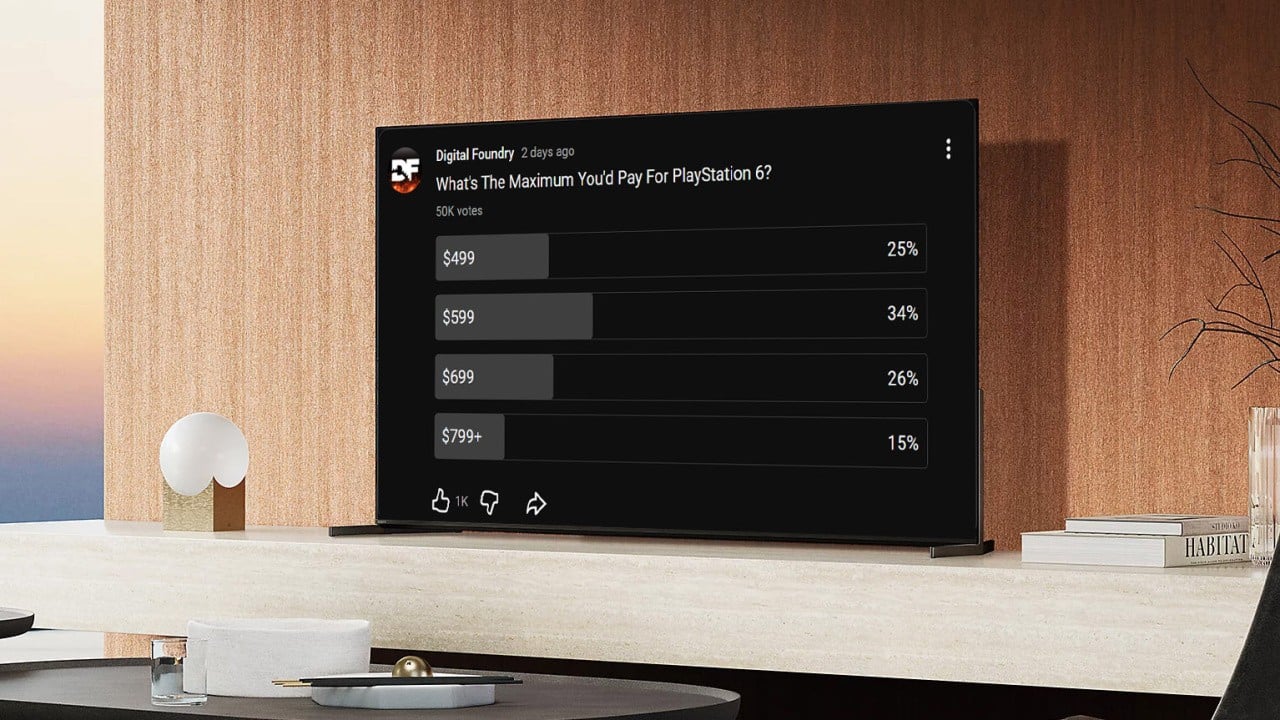
A YouTube poll of more than 50,000 votes found 41% of respondents would pay $699, $799 or more for a PlayStation 6, while 34% capped their maximum at $599 and 25% at $499. A smaller reader/Patreon poll was more optimistic on pricing, with 51% willing to pay $699 or $799+, aligning with estimates that Sony's bill of materials could be around $750 per unit. The article is speculative and centers on potential PS6 pricing, capabilities, and launch features rather than confirmed financial results.
The key read-through is not "PS6 demand is strong," but that a premium-priced hardware reset may still be viable if Sony can bundle enough differentiated value to preserve attachment rates. That matters because console cycles are really cash-flow cycles: if Sony pushes ASPs higher without a commensurate software/subscription uplift, the market will treat the launch as margin-accretive only on paper and worry about slower unit adoption, weaker third-party engagement, and a longer payback period on platform investment.
The more interesting second-order effect is on the ecosystem, not the console itself. A higher launch price increases the odds of a more bifurcated install base and a longer cross-gen period, which favors publishers with engine portability and live-service monetization while hurting pure console exclusives and any business dependent on rapid new-hardware penetration. It also raises the probability Sony leans harder on accessories, premium tiers, and first-party bundling to defend the installed base, which can support mix but usually compresses near-term hardware enthusiasm.
For investors, the decision point is timing: this is a years-out optionality story, not a near-term earnings catalyst. The stock reaction will be driven less by the eventual sticker price than by how Sony frames the value proposition versus PS5 Pro, handheld adjacency, and backward compatibility; the downside case is a premium console with mediocre differentiation, which would invite volume disappointment and force discounting later in the cycle. The contrarian angle is that the market may be underestimating how much Sony can offset a high MSRP through ecosystem monetization, meaning the bear case on unit volume could be right while the equity still works if software and services take a larger share of wallet.
AI-powered research, real-time alerts, and portfolio analytics for institutional investors.
Request DemoOverall Sentiment
neutral
Sentiment Score
0.05
Ticker Sentiment
