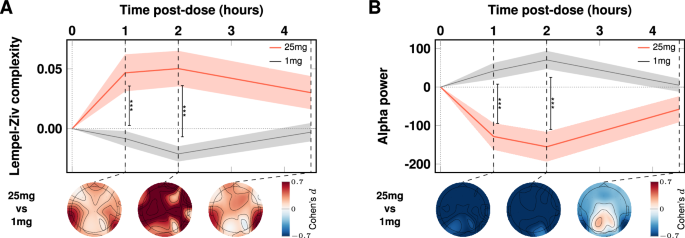
A placebo-controlled study in 28 psychedelic-naive healthy volunteers found that a single 25 mg dose of psilocybin produced lasting changes one month later, including decreased axial diffusivity in prefrontal-subcortical tracts, lower brain network modularity, improved cognitive flexibility, higher psychological insight, and better well-being. Acute EEG brain entropy at 1-2 hours post-dose predicted next-day insight and one-month well-being gains, with the insight effect mediating the longer-term well-being relationship. The findings were exclusive to 25 mg psilocybin; the 1 mg control dose showed no meaningful effects, but the study is exploratory and not yet broadly generalizable.
The key market implication is not that psychedelics work as a class, but that the value proposition is shifting from “acute efficacy” to “biomarker-led durability.” That matters because it raises the odds that future capital allocation in the space will favor platforms that can show a measurable, early signal tied to downstream behavioral benefit rather than relying on subjective endpoints alone. For incumbents, this is constructive for trial design sophistication and protocol credibility, but it also raises the bar: sponsors without objective translational readouts may face a steeper path to differentiation and financing.
Second-order, the most important competitive effect is on data defensibility. If acute EEG entropy and a small set of imaging-derived network features become accepted as leading indicators, then the moat shifts toward companies with repeatable IP around patient stratification, digital/physiologic monitoring, and companion diagnostics rather than just molecule ownership. That is favorable for a player with a broad development and partnership strategy, while smaller names that are story-driven but light on translational infrastructure may see relative multiple compression if the market starts rewarding “evidence density” over headline clinical narratives.
On risk, this is still early, small-N, and confounded by order effects and exploratory statistics, so the near-term reaction can overstate the durability of the findings. The right time horizon is months, not days: the tradeable impact comes when management teams start referencing these endpoints in upcoming readouts, investor decks, and protocol amendments. A negative surprise would be a failed replication in larger, between-subject studies, especially if multimodal biomarkers prove noisy outside highly controlled settings; that would quickly unwind any premium assigned to biomarker-heavy psychedelic platforms.
The contrarian view is that the headline is less about “brain change” and more about measurement sensitivity: the apparent signal may simply reveal that current fMRI/DTI paradigms are underpowered for healthy subjects, not that the biology is absent. If so, the market may be underpricing the eventual utility of EEG-based selection/enrichment tools and overpricing near-term structural MRI claims. In that framework, the best risk-adjusted exposure is not broad psychedelic beta, but the names best positioned to monetize a biomarker stack across trials and eventual commercialization.
AI-powered research, real-time alerts, and portfolio analytics for institutional investors.
Request DemoOverall Sentiment
mildly positive
Sentiment Score
0.35
Ticker Sentiment
