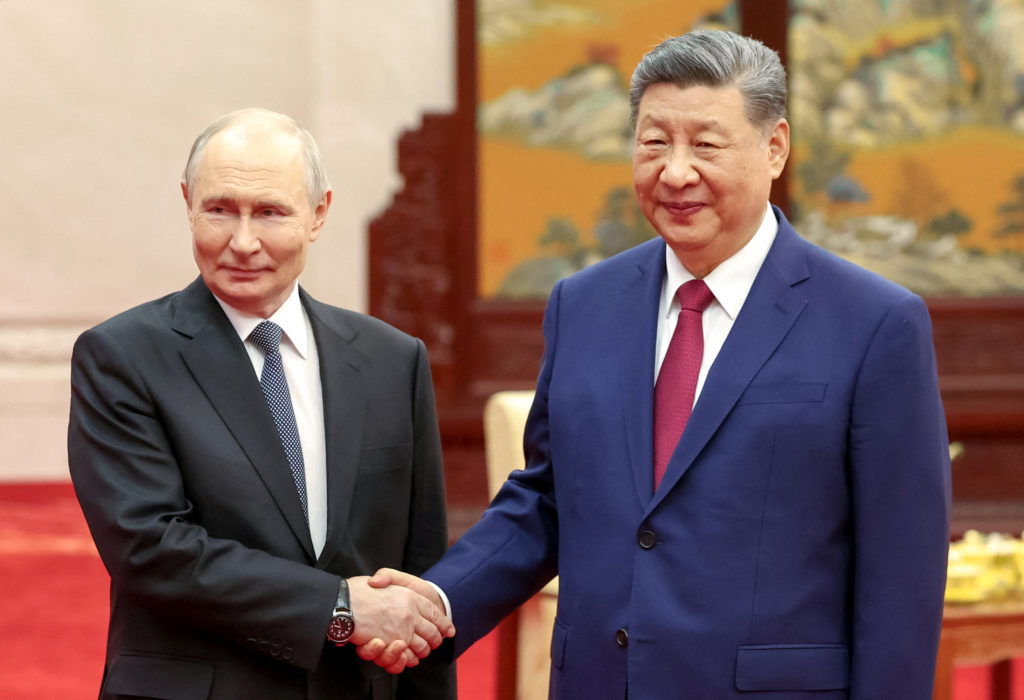
Putin and Xi used a Beijing meeting to publicly reinforce their strategic alignment while jointly criticizing U.S. foreign policy, including Trump’s proposed Golden Dome missile defense and the end of New START. The article highlights continued China-Russia economic and military cooperation, including China supplying an estimated 90% of Russia’s microelectronic imports and 70% of machine tool imports tied to the war in Ukraine. While no major deal was announced, the signals are negative for geopolitical risk and defense-related markets.
The more important market signal is not the optics of the meeting, but the accelerating formation of a sanctions-resilient industrial bloc. If Beijing is willing to keep underwriting Russia’s war economy through dual-use inputs, the West’s export-control regime is morphing from a blunt deterrent into a tax on compliant firms while gray-channel trade captures more share. That tends to prolong elevated defense spending, preserve a floor under European energy-security capex, and keep freight, insurance, and payments frictions structurally higher for longer.
The missing second-order effect is on European industrial competitiveness. A deeper Russia-China alignment increases the probability that Europe continues to de-risk supply chains away from China and from Russian commodities simultaneously, which is inflationary for inputs and bearish for margin-sensitive cyclicals. In energy, the absence of a gas pipeline deal is notable: it suggests China still has pricing leverage and is not yet prepared to lock in long-dated dependence, so the market should treat any near-term energy collaboration headlines as tactical rather than transformational.
From a timing perspective, the near-term catalyst is not a new treaty or pipeline; it is tighter enforcement and retaliatory export controls over the next 1-3 quarters. That creates asymmetric upside for defense primes and select European energy infrastructure names, while pressuring Asian industrial exporters with high China-Russia exposure if secondary-sanctions risk expands. The main reversal condition is a genuine U.S.-China thaw with verifiable enforcement on dual-use goods, but that looks more like a year-plus political process than a quarter-end tradeable shift.
The consensus is likely underestimating how much of this is already priced into headline geopolitics and overestimating how quickly markets can re-route critical supply chains. The bigger mispricing is in the lagged beneficiaries of persistent fragmentation: defense procurement, grid hardening, LNG logistics, and sanctions-compliance software. This is a slow-burn regime trade, not a one-day geopolitical shock.
AI-powered research, real-time alerts, and portfolio analytics for institutional investors.
Request DemoOverall Sentiment
mildly negative
Sentiment Score
-0.20
