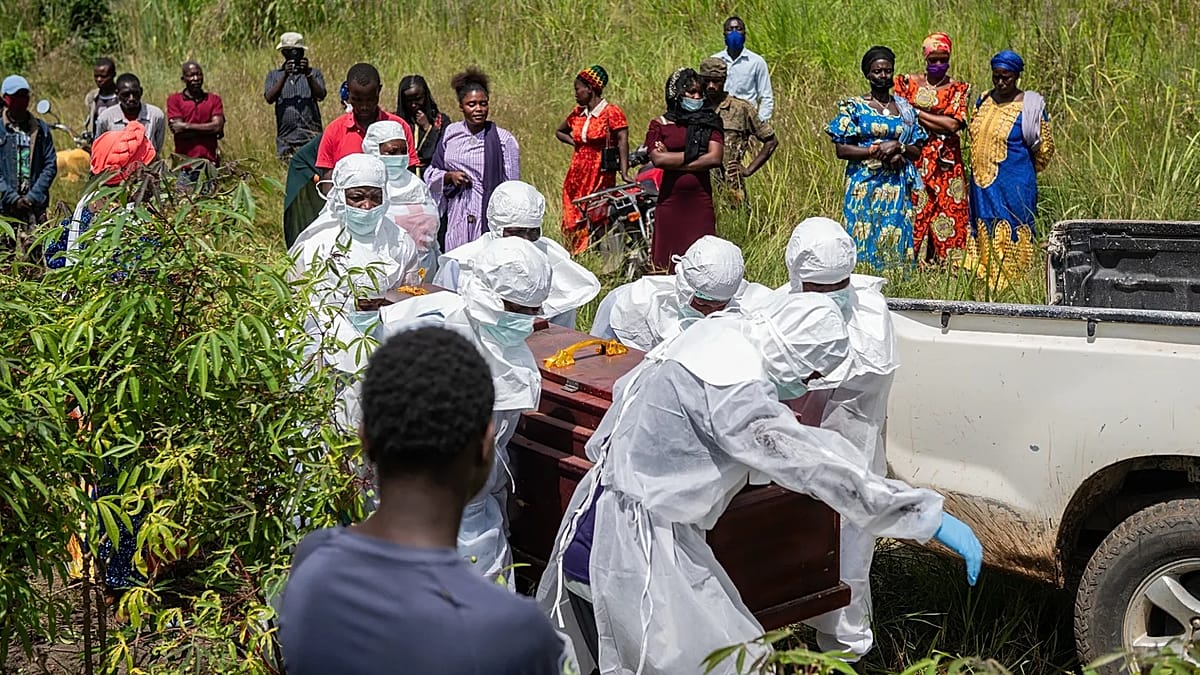
Three Red Cross volunteers in the Democratic Republic of the Congo died from suspected Ebola infections, with the outbreak in Ituri Province now linked to 82 confirmed cases and 7 confirmed deaths. WHO said the broader outbreak may be much larger, estimating around 750 suspected cases and 177 suspected deaths, while Uganda reported 3 additional confirmed cases, bringing its total to 5. The WHO has raised the DRC risk level to "very high," signaling a worsening regional public health emergency.
The immediate market read is not about a broad pandemic shock, but about operational drag in a region with already fragile logistics. Expect a second-order hit to the local response stack: burial teams, community health workers, transport corridors, and informal trade routes will become more cautious, slowing containment precisely when speed matters. That typically means a longer tail for case discovery, which is the real risk to regional stability rather than headline fatality counts.
For healthcare and biotech, the tradeable implication is a modest but persistent bid for names exposed to outbreak diagnostics, sample transport, PPE, and field-deployable treatment infrastructure. The larger opportunity is in companies with credible low-cost point-of-care testing or cold-chain/logistics capabilities in sub-Saharan Africa; these businesses can see small procurement wins that compound over months if surveillance expands. Conversely, local insurers, airlines, and consumer-facing EM names with East African revenue exposure face a low-probability/high-impact demand shock if cross-border controls tighten.
The contrarian view is that the market may overestimate global spillover and underestimate the duration of localized containment costs. With the global risk still low, the wrong way to play this is a broad risk-off bet; the cleaner edge is to fade complacency in regional logistics and travel while staying selective on healthcare enablers. The key catalyst window is the next 2-6 weeks: if case ascertainment improves quickly, the trade becomes a short-duration event; if suspected cases continue to outpace confirmed cases, expect a prolonged draw on public-health resources and a wider economic footprint.
The main tail risk is not the virus leaving the region; it is response-system overload in hard-to-reach areas, which can force repeated movement restrictions and disrupt agricultural supply chains ahead of the next planting/harvest cycle. That creates a higher probability of earnings misses for companies with DRC/Uganda exposure than the headline epidemiology alone suggests. A deterioration in neighboring-country case counts would be the signal to scale exposure, because border frictions can extend the economic impact far beyond the initial outbreak zone.
AI-powered research, real-time alerts, and portfolio analytics for institutional investors.
Request DemoOverall Sentiment
strongly negative
Sentiment Score
-0.80
