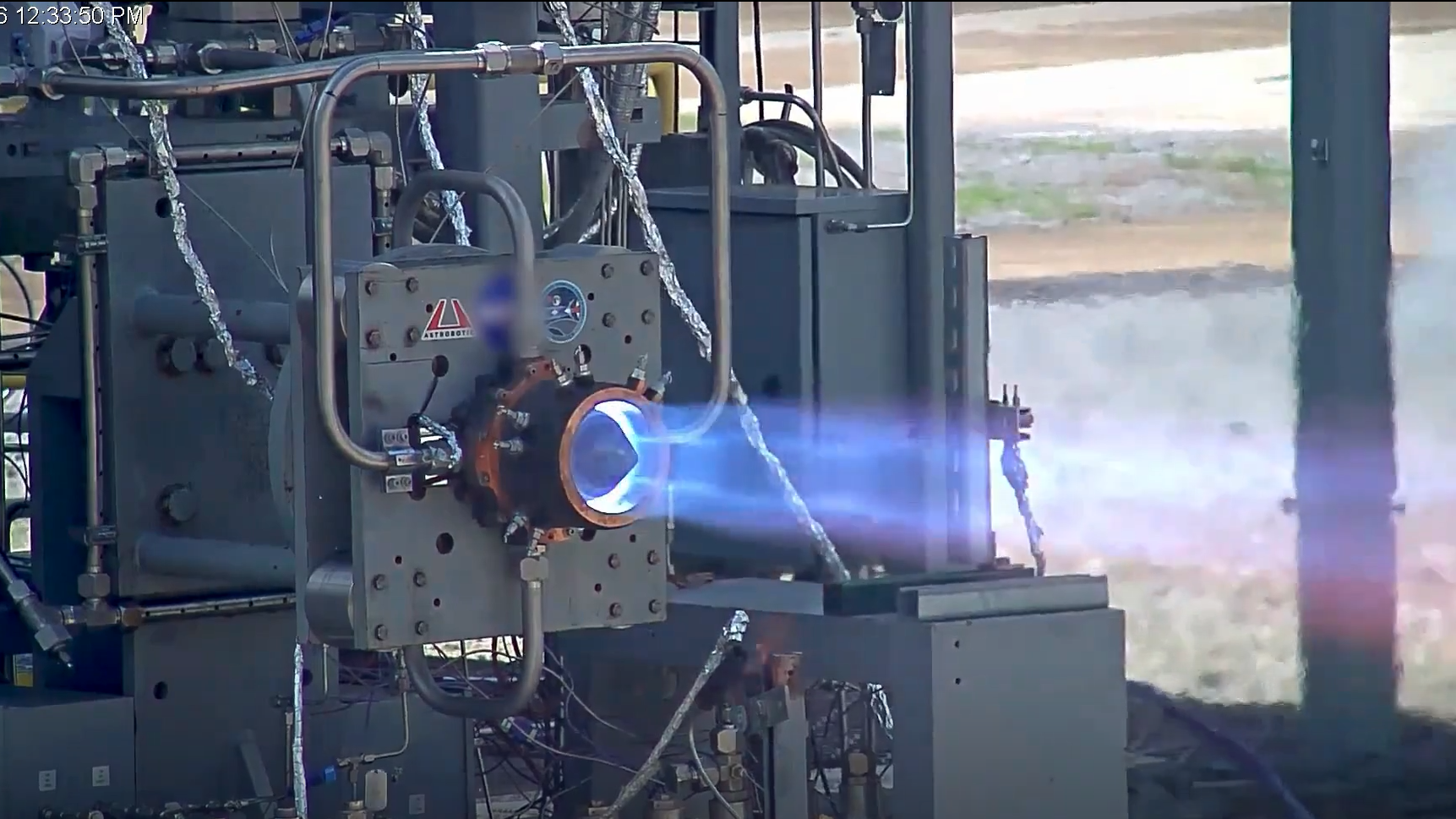
Astrobotic completed hot-fire testing of its rotating detonation rocket engine prototype Chakram, with more than 470 seconds of cumulative firing time and a single continuous burn of 300 seconds, likely the longest sustained RDRE test to date. Each engine produced over 4,000 pounds of thrust and reached stable thermal steady-state conditions with no visible damage, advancing the technology toward flight readiness. The work supports future lunar landers, reusable rockets, and cislunar orbital transfer vehicles, but the broader market impact is likely limited.
This is a credibility inflection, not a commercial revenue event. The meaningful signal is that RDRE has moved from lab novelty toward a manufacturing-and-thermal-management problem, which matters because propulsion incumbents have been constrained more by engineering risk than by physics. If the durability claim holds, the first-order beneficiary is not just Astrobotic but any small launch/cislunar platform that can trade engine complexity for payload margin and mission flexibility.
The second-order effect is on the space supply chain: advanced additive manufacturing, refractory materials, high-temp alloys, injectors, and test infrastructure become the gating items. That shifts value capture away from pure software/missions toward component suppliers and defense-adjacent contractors with qualification heritage. The more interesting competitive angle is that success here pressures a broad set of lunar/cislunar contenders to justify why they are still flying lower-efficiency conventional propulsion for high-value missions.
The market is likely to overestimate the timeline to monetization. A long-duration ground test can compress perceived technical risk, but flight qualification, repeatability, throttle control, and integration into an actual spacecraft stack are multi-year hurdles; any setback will hit the story hard and likely reset expectations by 12–24 months. Near-term upside is mostly sentiment-driven around NASA SBIR-style validation, while the real economic payoff only emerges if this becomes a reusable subsystem across multiple programs.
Contrarian view: the headline may be less about Astrobotic alone and more about the validation of cislunar infrastructure as a category. If investors read this as a single-company win, they may miss that the broader opportunity is in enabling more frequent, lower-mass transfers and lunar logistics, which could expand demand for launch, testing, and mission services well before RDRE itself becomes a standalone product. The risk is that the technology becomes strategically important but commercially commoditized, with margins accruing to whoever owns the contract channel rather than the engine IP.
AI-powered research, real-time alerts, and portfolio analytics for institutional investors.
Request DemoOverall Sentiment
moderately positive
Sentiment Score
0.62
