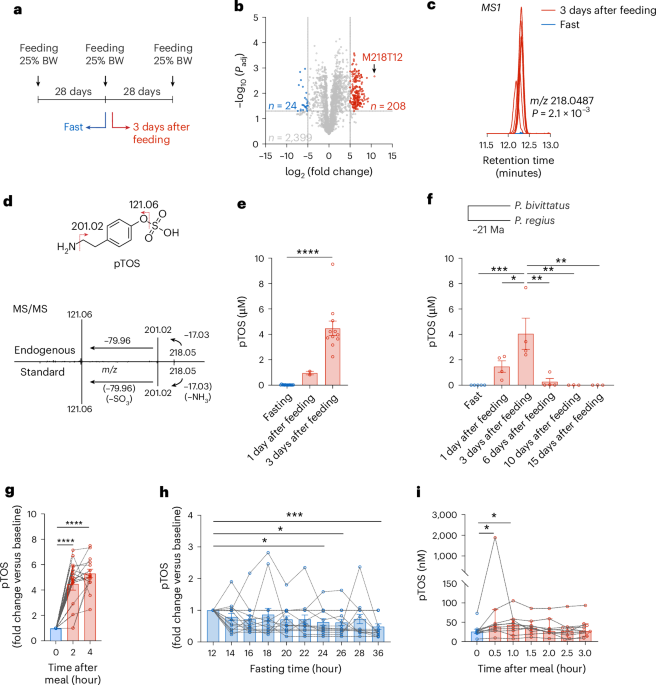
Key finding: para-tyramine-O-sulphate (pTOS) increases >1,000-fold postprandially in pythons and rises ~2–5× on average in multiple human meal tests (with occasional individuals reaching µM levels). Preclinical results: exogenous pTOS (50 mg/kg) reduced 24‑h food intake in mice and produced a −9% vehicle‑adjusted body‑weight change in diet‑induced obese males; mechanism mapped to VMH neurons in the hypothalamus. Commercial/clinical relevance: a provisional patent has been filed for pTOS in cardiometabolic disease, suggesting biotech licensing or startup interest, but development remains at an early preclinical stage with significant translational risk.
This paper creates a new, investable axis: gut‑microbiome → sulfated small molecules → CNS receptors. The near-term commercial winners are platform companies that supply discovery infrastructure (LC–MS, isotope standards, proteomics reagents) and CDMOs that can synthesize sulfated small molecules at scale — those firms capture recurring, low‑signal but durable revenue as academic hits are triaged into translational programs. A second‑order beneficiary is the growing GPCR deorphanization ecosystem (deconvolution assays, cell‑based screening libraries) because the value of a metabolite story scales only when a cognate receptor is found and human pharmacology is demonstrated.
Key risks compressing valuation: translational uncertainty (high inter‑individual variability in human responses and the absence of a murine endogenous analogue) and IP concentration — a Stanford provisional on pTOS plus broad claims around use in cardiometabolic disease would raise licensing costs and slow venture exits. Near‑term catalysts that would re‑rate names are receptor identification and a human Phase I demonstrating consistent, dose‑dependent anorexia without CNS safety signals; negative signals would de‑rate the whole subtheme rapidly.
Time horizon and strategy: expect 6–24 months for technology vendors to show measurable revenue inflection from follow‑on metabolite programs, and 2–6 years for clinical readouts. Monitoring discrete readouts (academic receptor papers, IND filings, university licensing auctions) provides high‑information, low‑noise triggers more useful than headlines about “new obesity molecule.” For allocators, the efficient exposure is to instruments/consumables and diagnostics rather than early single‑asset biotechs until receptor and human replication are proven.
AI-powered research, real-time alerts, and portfolio analytics for institutional investors.
Request DemoOverall Sentiment
mildly positive
Sentiment Score
0.25
Ticker Sentiment
