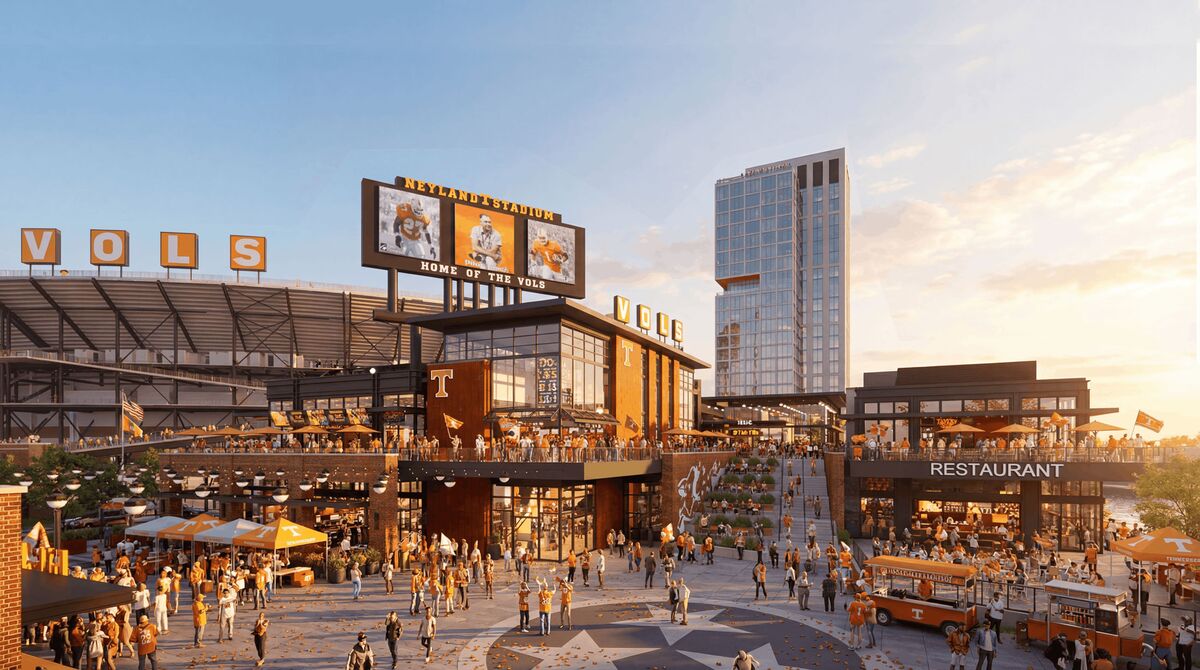
Arctos Partners, backed by KKR, is participating in a $288 million joint venture to develop a mixed-use entertainment district adjacent to the University of Tennessee's Neyland Stadium. The project includes a 24-story hotel, apartments, a private club, and 100,000 square feet of entertainment space, highlighting growing private-market investment in college sports-related real estate. The news is positive for the involved development firms but is unlikely to have a broad market impact.
This is less a one-off stadium adjacency deal than a proof-of-concept for a repeatable, institutionalized monetization layer around live sports. The economic punch is in land control and captive foot traffic: if these districts work, they convert event-day demand into year-round rent, hotel ADR, and membership revenue, which should attract more capital into college-sports ecosystems and push up valuations for developers with entitlement expertise and balance-sheet flexibility.
The second-order beneficiary is KKR itself: the market still underappreciates how much fee-bearing AUM can be created from sports-adjacent real estate and operating businesses that sit outside the traditional buyout cycle. That creates a cleaner, longer-duration capital base with multiple monetization paths, but it also introduces execution risk because these assets are capital intensive, slower to stabilize, and more exposed to local permitting and demand sensitivity than headline sports franchise stakes.
The contrarian angle is that consensus may be too quick to extrapolate scarcity value. Mixed-use districts near stadiums can look compelling on paper, but they are vulnerable to overbuilding, event-calendar volatility, and a mismatch between premium concepts and local spending power; the real bottleneck is often not capital, but absorption and operational leverage. If this turns into a template, the winners will be the platform owners and entitlement specialists, while undisciplined capital could compress returns across the sector over a 2-4 year horizon.
Near term, the tradeable implication is not a direct read-through to the stadium asset itself but to KKR’s ability to source adjacent, higher-fee private-market opportunities with branded scarcity. The setup is modestly positive over months, but the bull case only compounds if similar projects get announced in other college markets, which would validate the rollout and expand the investable universe. Absent that, this remains a narrative win more than an earnings catalyst.
AI-powered research, real-time alerts, and portfolio analytics for institutional investors.
Request DemoOverall Sentiment
mildly positive
Sentiment Score
0.20
Ticker Sentiment
