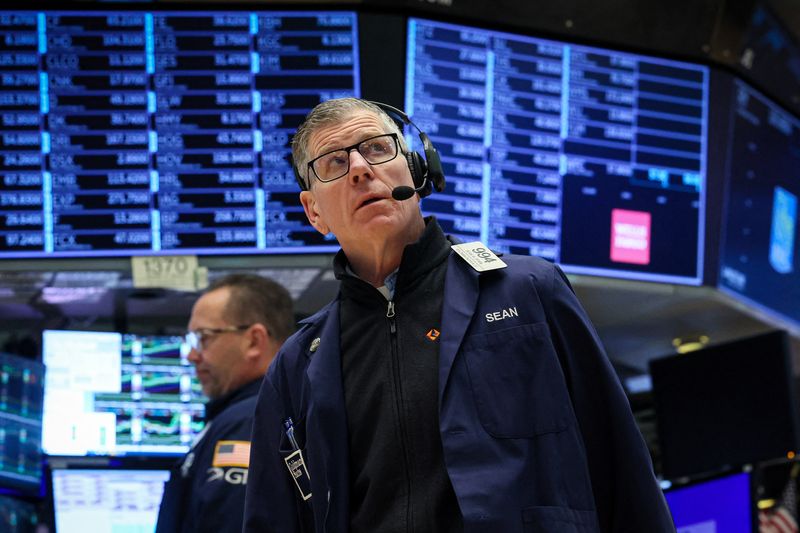
U.S. stock futures were little changed after Wall Street sold off, as renewed Iran-U.S. hostilities in the Strait of Hormuz and a roughly 6% jump in oil prices pressured risk assets. The S&P 500 fell 0.4% to 7,200.81, the Nasdaq Composite dropped 0.2% to 25,067.80, and the Dow Jones Industrial Average slid 1.1% to 48,941.90. Investors are now focused on Tuesday earnings from AMD, Shopify, KKR and Strategy, plus Friday's April nonfarm payrolls report.
The market is beginning to price a classic energy-shock regime, but the bigger near-term implication is not just higher oil beta — it is a widening dispersion across sectors with fragile margins and balance sheets. Transportation, chemicals, airlines, consumer discretionary, and any company with low pricing power are the first-order losers, but the second-order effect is that higher input costs can force earnings resets in sectors that had just begun to re-rate on AI/tech optimism. That makes the tape more vulnerable to de-grossing rather than a simple rotation.
The strongest second-order setup is in inflation-sensitive duration: if crude holds elevated for even 2-4 weeks, breakevens and rate-cut odds can reprice quickly, putting pressure on long-duration growth multiples even if nominal growth looks fine. That matters most for high-multiple software and hardware names that are currently trading on multiple expansion rather than estimate revisions. In that context, the positive earnings prints in semis may prove less durable if the market shifts from “AI capex scarcity” to “macro multiple compression.”
The geopolitical path is binary, but the trading path is not. If the situation de-escalates within days, oil likely gives back a meaningful chunk of the move, but if shipping risk persists for several sessions, insurers, shippers, and commodity-volatility names can continue outperforming even without further headlines. The market is underestimating how quickly a perceived disruption in a chokepoint can bleed into global inflation expectations and commodity curves, even before any physical supply loss shows up in inventories.
AI-powered research, real-time alerts, and portfolio analytics for institutional investors.
Overall Sentiment
strongly negative
Sentiment Score
-0.55
Ticker Sentiment
