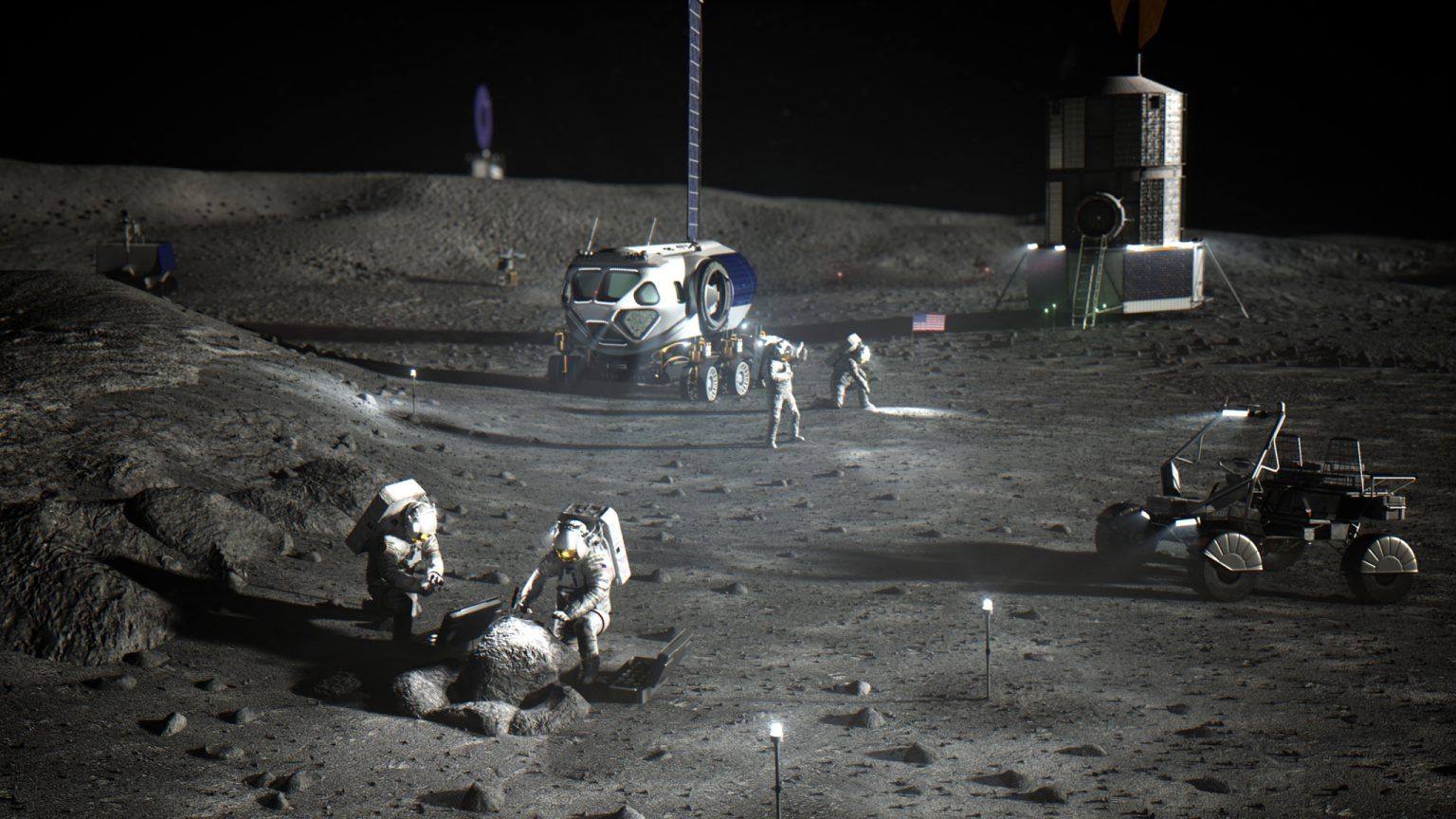
NASA-funded research and in-service robotic missions are producing operational tools and datasets to de-risk planned human missions to the Moon and Mars, including a Mars surface space-weather dashboard integrating MAVEN, Curiosity and Perseverance data and a MAVEN catalog spanning a full solar cycle (2014–2025). Key program-level developments include selection of a $24.8 million DUSTER dust-and-plasma suite for Artemis IV, development of a Compact Electrostatic Dust Analyzer (CEDA), an imaging spectrometer chosen in July to map lunar water/minerals, and work on miniaturized magnetometers for high-resolution crustal-field mapping; policy drivers include a Dec. 18 executive order directing a lunar return by 2028 and initial base elements by 2030 under new NASA leadership.
Market structure: NASA's renewed moon/Mars push disproportionately benefits aerospace primes (Lockheed Martin LMT, Northrop Grumman NOC, Boeing BA, Raytheon RTX) and specialty instrumentation suppliers (Teledyne TDY, L3Harris LHX) that supply spectrometers, magnetometers and dust sensors. Small-cap space optics/data plays (Planet Labs PL, Spire SPIR) and pure-play consumer-space names (Virgin Galactic SPCE) are structurally weaker because robotic-to-human transition favors flight‑proven hardware and government contracting over speculative commercial services; expect a 6–18 month reallocation of award spending toward primes and instrument OEMs. Supply/demand: demand for payload electronics, radiation-monitoring dashboards and dust‑tolerant hardware will grow at a multi‑year CAGR (high single digits), tightening niche instrument capacity and supporting 5–15% price/margin tailwinds for specialized suppliers over 12–36 months.
Risk assessment: Tail risks include budget cuts or reprioritization (Congress reduces NASA funding by >10% over FY baseline in 12–24 months), mission failures (Artemis IV delay >12 months) or geopolitical export controls that disrupt supply chains. Immediate (days/weeks): minimal market reaction; short term (3–12 months): procurement award cycles will move liquidity toward primes; long term (2–5 years): structural winner-take-most effects favor integrated primes and vertically integrated instrument suppliers. Hidden dependencies include commercial launch cadence (SpaceX/ULA availability) and rare‑earth/microelectronic supply constraints that can bottleneck instrument delivery.
Trade implications: Favor concentrated long exposure to defense primes and instrument OEMs with 12–36 month horizons (target 1–3% portfolio positions each), hedge with short positions in speculative consumer-space operators. Use options to define risk: 9–18 month call spreads on LMT/LHX to capture contract awards while limiting premium; volatility on small caps suggests cheap opportunity for selling premium against index‑hedged positions. Sector rotation: reduce pure-play space tourism and unprofitable LEO data plays, rotate into Aerospace & Defense ETFs (ITA, XAR) and specialty industrials (TDY) over next 3–6 months.
Contrarian angles: Consensus underestimates margins for instrument makers — CEDA/DUSTER-style payloads are high-value, low-volume products that can carry >10% incremental margin; don’t overpay for consumer-space narratives (SPCE) whose cash burn is exposed if government partnership wins concentrate. Historical parallel: post‑Apollo era showed long funding cliffs followed by concentrated contractor consolidation; a 20–30% drawdown in small-cap space stocks is plausible if program timelines slip. Unintended consequence: accelerated robotic investments may crowd out commercial science contracts, benefiting primes but amplifying political scrutiny of cost overruns — use contract‑award cadence as a 3–9 month catalyst signal.
AI-powered research, real-time alerts, and portfolio analytics for institutional investors.
Request DemoOverall Sentiment
neutral
Sentiment Score
0.10
