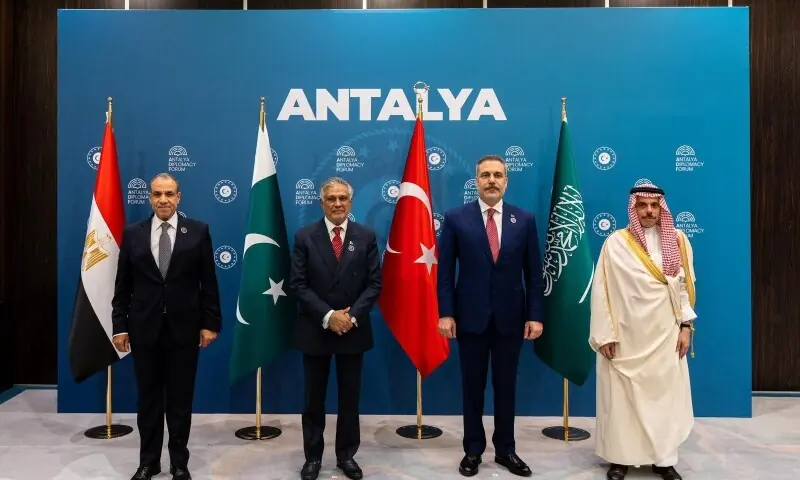
Pakistan, Saudi Arabia, Turkiye and Egypt held diplomatic talks on the sidelines of the Antalya Diplomacy Forum to coordinate responses to regional tensions and the US-Iran conflict. The ministers reaffirmed support for dialogue and said they are working on a framework for lasting peace, with Egypt noting efforts to protect Gulf states and stabilize energy markets, supply chains and food security. The article signals ongoing de-escalation efforts rather than a concrete breakthrough, but it has some relevance for regional risk sentiment and energy markets.
The practical market signal is not the diplomacy headline itself but the emerging role of a Pakistan-led backchannel as a de-escalation venue. That matters because it reduces the probability of a disorderly regional shock premium in oil, freight, and insurance, even if it does not yet produce a durable settlement. In the near term, this compresses the tail-risk premium embedded in Gulf exposure and lowers the odds of a sudden supply interruption narrative over the next 1-3 weeks.
The second-order beneficiary is the broader EM and trade complex: if Gulf security fears ease, importers with energy sensitivity — India, Turkey, parts of ASEAN — get an incremental terms-of-trade tailwind, while fertilizer, shipping, and airlines avoid a volatility spike. Conversely, the obvious losers are long-vol energy volatility expressions and any positioning predicated on an imminent escalation in Strait-of-Hormuz risk. This is less about absolute oil direction and more about suppressing left-tail convexity that had been supporting crude, tanker insurance, and defense-adjacent equities.
The key risk is that diplomacy buys time rather than resolution. A temporary ceasefire window expiring in days creates a classic event-risk setup where markets may over-interpret meeting count as substance; if talks stall, the rebound in risk premia could be fast and binary. Over a 1-2 month horizon, the more important variable is whether this framework leads to measurable security guarantees around Gulf energy infrastructure; absent that, volatility likely re-prices higher again.
The contrarian view is that consensus may be too focused on oil supply disruption and underestimating policy coordination on the demand side. If Gulf states are already being framed as stability anchors, they may use the pause to harden logistics, reroute trade, and pre-position inventories, making the market impact smaller than headline risk suggests. That argues for selling panic spikes rather than owning persistent war premium.
AI-powered research, real-time alerts, and portfolio analytics for institutional investors.
Request TrialOverall Sentiment
neutral
Sentiment Score
0.05
