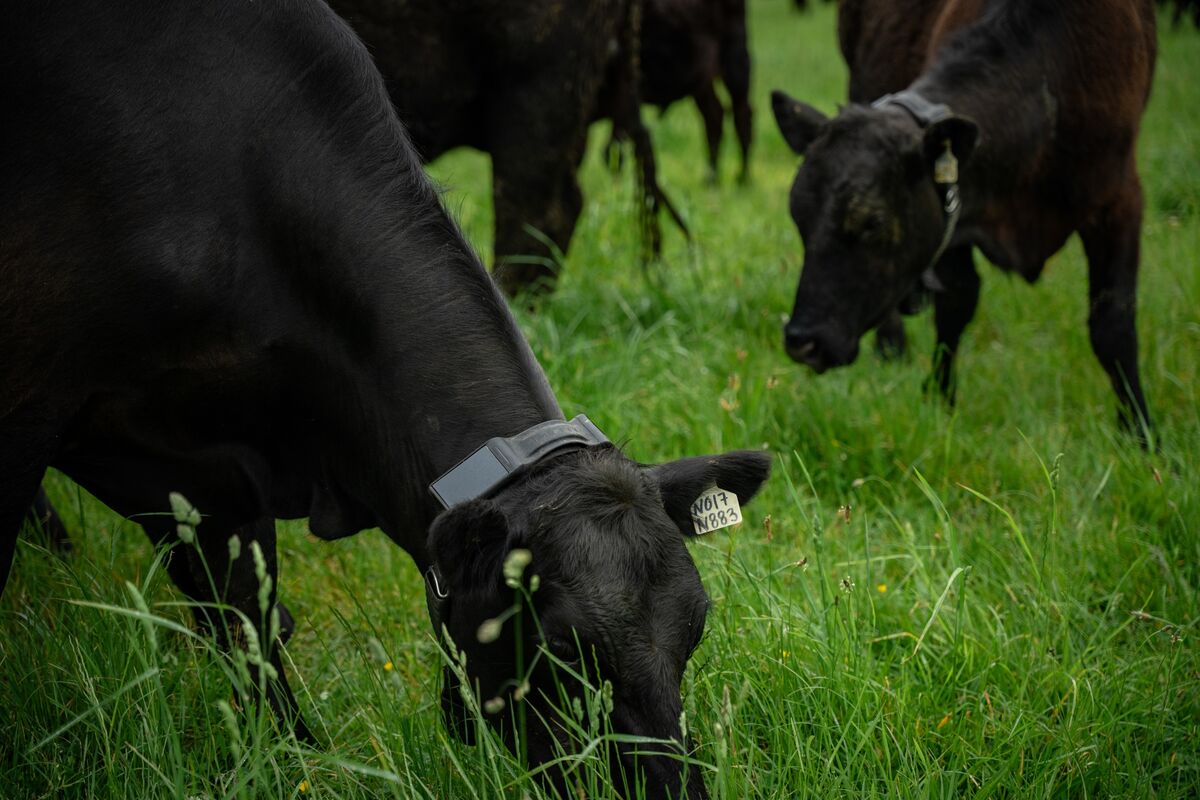
Halter is in talks to raise a new funding round that would double its valuation to more than $2 billion, with Peter Thiel’s Founders Fund set to lead the financing. The potential round signals strong investor interest in AI-powered agritech and could boost private-market valuation comps for similar startups, though talks are ongoing and terms may change.
This financing dynamic accelerates a shift from one-off hardware sales to recurring-data businesses inside animal agriculture: collars create high-frequency telemetry that can be monetized (alerts, disease detection, fertility optimization), converting seasonal, lumpy ag revenues into subscription-like streams worth higher multiples. The immediate industrial winners are low-power edge-AI silicon and connectivity providers (IoT modems, LPWAN), plus telemetry/cloud analytics vendors who can scale SaaS margins quickly; OEM farm-equipment players face a strategic choice to build, partner, or buy to avoid being relegated to commoditized chassis suppliers.
Adoption risk is concentrated in unit economics and farmer ROI cadence: adoption will be pilot-driven over 6–24 months and hinges on a clear path to payback (reduction in vet costs, increased yield per animal) for mid-size operations. Regulatory/data-governance shocks (privacy of farm data, cross-border veterinary rules) or failure modes (battery life, false-positive analytics) can stall deployments and reset private-market multiples within quarters.
A crowded private-market raises a consolidation thesis: incumbents with distribution (Zoetis, large OEMs) can acquire scale cheaply and convert ARR to predictable FCF, while standalone hardware-heavy plays face margin compression as component costs fall. On the commodity side, measurable herd productivity gains of even low-single-digit percent, if widely adopted over 2–4 years, will be a deflationary force for protein/dairy prices and create asymmetric outcomes between input-tech winners and downstream commodity processors.
AI-powered research, real-time alerts, and portfolio analytics for institutional investors.
Request DemoOverall Sentiment
moderately positive
Sentiment Score
0.60
