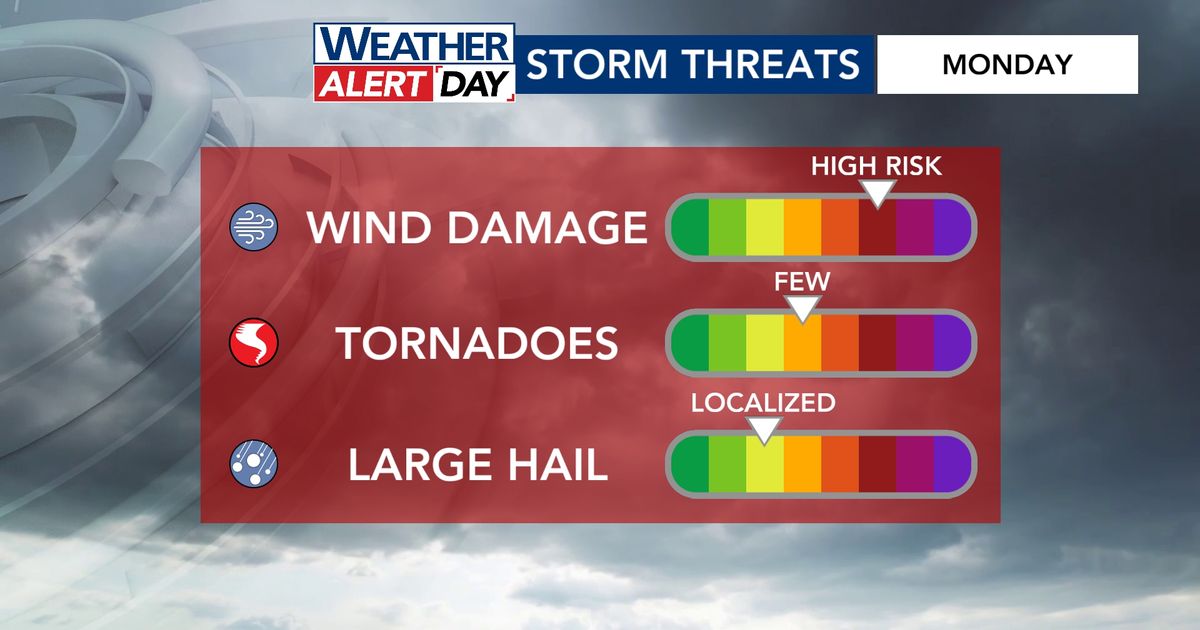
NOAA's Storm Prediction Center has issued a rare Level 4 (of 5) risk for Monday, with damaging wind gusts forecast at 55-75 mph and tornadoes possible. The event is expected in two waves: discrete supercells after about 9:00 a.m. and the main line arriving from the west after ~2:00 p.m., tapering off after 3-4 p.m. Expect potential localized disruptions to power, infrastructure and regional logistics that could temporarily affect operations.
Localized severe convective events transmit economically through three tight channels: immediate retail/distribution demand for emergency supplies and backup power, short-lived labor/transport disruptions that compress local retail sales, and concentrated insured losses that stress P&C loss ratios for the following quarter. Empirically, outages and prep-buying can lift big-box home improvement weekly sales in affected ZIPs by mid-single digits for 1–2 weeks, and generator vendors typically see a 20–50% spike in short-term order flow after high-impact wind events.
Insurers and reinsurers are the first financial layer to price in losses; a modest scenario (many small wind claims) produces high frequency/low severity payouts that hit combined ratios but stay within aggregate retentions, while a tail scenario (localized structural/tornado damage) produces fewer but larger claims that can bite through retentions and trigger retrocession/reinsurance draws. Expect earnings volatility to surface in next quarter’s releases and for reinsurance pricing conversations to accelerate regionally over the next 2–6 months.
Logistics and supply-chain second-order effects matter: route cancellations and depot slowdowns tend to create 48–120 hour processing backlogs that cascade into inventory shortfalls for JIT-dependent stores but benefit local warehouses with on-shelf inventory. That bifurcation creates short windows where physical retailers and generator/home-improvement suppliers capture outsized cash flow while parcel carriers and regional hospitality names see transient headwinds.
AI-powered research, real-time alerts, and portfolio analytics for institutional investors.
Request DemoOverall Sentiment
neutral
Sentiment Score
0.00
