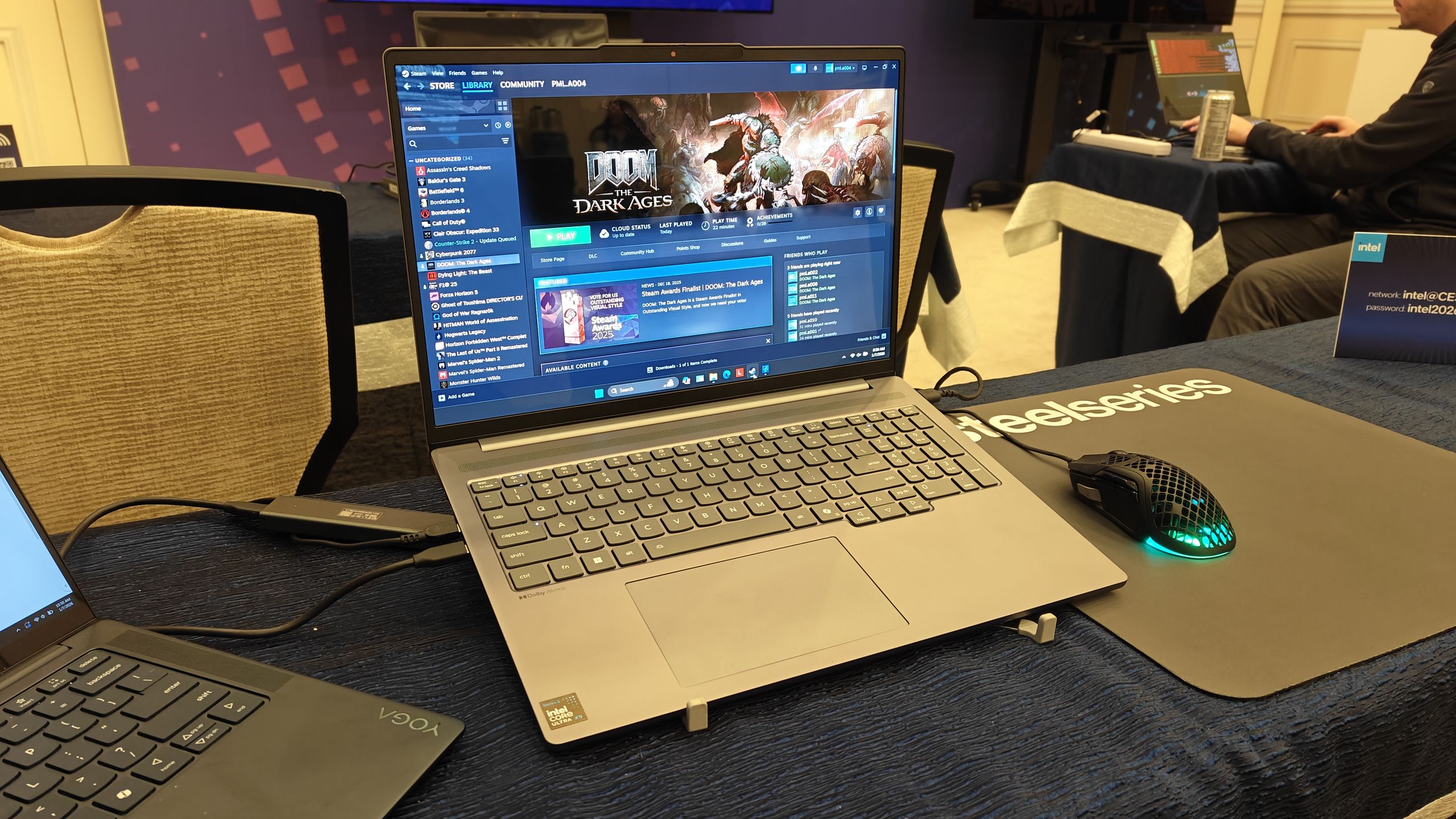
Intel’s new Panther Lake X-series (example: Core Ultra X9 388H) ships a 12‑core Xe3 integrated GPU on an 18A process and in early Lenovo reference testing delivered competitive 1080p/1200p gaming performance (e.g., Cyberpunk 2077 ~81 fps, F1 2025 ~109 fps, Baldur’s Gate 3 ~68 fps) with reported PL1/PL2 package power limits of 65W/85W. Reviewers highlight strong efficiency, low thermals and promising discrete‑GPU‑level performance for thin‑and‑light systems, but flag material software/driver and XeSS quality issues that constrain real‑world consistency; implications include potential pressure on laptop dGPU adoption but limited near‑term market disruption until software maturity and broader OEM deployments arrive.
Market structure: Panther Lake’s 12‑Xe3 X‑series threatens the low‑end discrete mobile GPU bucket (RTX 4050/4060 class) by offering near‑equivalent 1080p performance at 65–85W SoC TDP and materially better efficiency; conservatively assume Intel can seize 3–7% of global gaming laptop GPU share within 12–24 months if drivers mature and OEMs adopt. Winners are INTC (upside to mobile CPU/SoC ASPs and share gains) and OEMs selling premium thin‑and‑light systems (e.g., DELL’s XPS margin uplift); losers include mobile discrete GPU revenue pools (impacts AMD’s mobile GPU mix and potentially Nvidia’s low‑tier mobile), pressuring ASPs by mid‑2026.
Risk assessment: biggest tail risks are persistent driver/XeSS failures (software adoption failure) and manufacturing hiccups on Intel’s 18A ramp that could delay supply — either can wipe expected share gains within 3–9 months; regulatory/antitrust risk is low near‑term but OEM bundling deals could change economics. Hidden dependencies include ISV/XeSS integration and OEM thermal/BIOS tuning — until Jan 27 broad system reviews and OEM SKUs ship, real adoption risk remains binary; catalysts to watch: January 27 full benchmarks, quarterly OEM order announcements (next 60–120 days), and AMD/Nvidia product/price responses.
Trade implications: tactically favor a modest overweight to INTC (as a 2–3% active position) with a 12‑month horizon, target +20% upside if adoption evidence appears by Q2 2026, stop‑loss −12% on failure to show OEM rollouts or worsening guidance. Pair trade: establish dollar‑neutral pair long INTC / short AMD at 1:0.5 size (i.e., long 2% INTC vs short 1% AMD) to express iGPU share shift while hedging CPU macro risk. Use options: buy a small INTC 6‑month call spread (10–20% OTM buy/sell) sized 0.5–1% portfolio to cap cost, and a 3–6 month AMD put spread (10–20% OTM) 0.5% to benefit from mobile GPU pressure.
contrarian: consensus underestimates software dependency — hardware claims alone won’t move OEM procurement without stable drivers and ISV wins; if Intel’s XeSS quality improves in 30–90 days, adoption could accelerate nonlinearly (upside surprise >30% market re‑rating). Conversely, OEMs may still pair high‑end SKUs with discrete GPUs (muting cannibalization), meaning the market could be underestimating AMD/Nvidia resilience; watch order bookings and OEM configuration share weekly/quarterly — these datapoints will disprove either narrative quickly.
AI-powered research, real-time alerts, and portfolio analytics for institutional investors.
Request DemoOverall Sentiment
mildly positive
Sentiment Score
0.25
Ticker Sentiment
