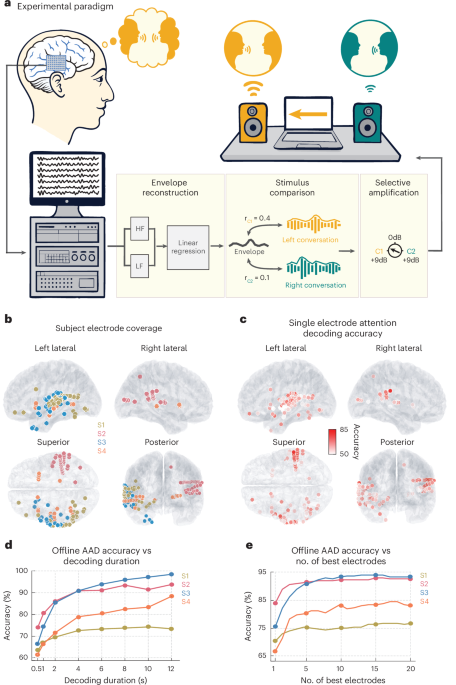
The study reports a real-time brain-controlled hearing system that improved speech intelligibility, reduced listening effort, and was preferred by subjects, with an average +12 dB target-to-masker ratio boost in the activated condition. In 40 hearing-loss participants, the AAD-enhanced audio was strongly preferred and significantly improved intelligibility, supporting translational potential for future assistive hearing devices. The work is scientifically important for auditory BCIs, though immediate market impact is limited because it remains a research-stage neurotechnology.
This is a validation event for the broader neurotech stack, not just a hearing story. The key second-order effect is that it de-risks the category shift from passive signal acquisition to closed-loop intent decoding, which should improve the market’s willingness to underwrite implantable and hybrid assistive devices with premium multiples. The real commercial moat is not the decoder alone; it is the combination of sensing, latency control, and perceptual QA that turns noisy inference into a user-trusted product loop.
The near-term winners are the enabling layers: neural data acquisition, real-time DSP, and speech separation vendors that can sit upstream of a brain-steered interface. This also strengthens the case for hearing-device incumbents to accelerate partnerships rather than build in-house, because time-to-market matters more than perfect decoding and the critical failure mode is user annoyance, not raw accuracy. Any company with low-latency edge AI, implantable telemetry, or auditory enhancement IP should see a modest multiple uplift if investors extrapolate this result into a faster path for premium “intent-aware” hearing products.
The main contrarian point is that the addressable market is likely farther out than the headline suggests. The demonstration is scientifically important but commercially constrained by invasiveness, clinical workflow, and the need for stable high-fidelity signals; those are years, not quarters, away from consumer scale. The market may overprice near-term TAM expansion for hearing aids while underestimating that the first monetization path is likely premium clinical devices, epilepsy-adjacent implants, and licensing rather than mass-market wearables.
Risk-wise, the setup is strong on a 6–18 month research/partnership horizon, but fragile on any announcement cycle if follow-on studies fail to replicate on less invasive modalities. The main reversal catalyst would be a competing noninvasive or ear-EEG approach that closes most of the performance gap, which would compress the value of invasive-first narratives and shift spend toward software and sensor fusion instead of implants.
AI-powered research, real-time alerts, and portfolio analytics for institutional investors.
Request DemoOverall Sentiment
strongly positive
Sentiment Score
0.75
Ticker Sentiment
