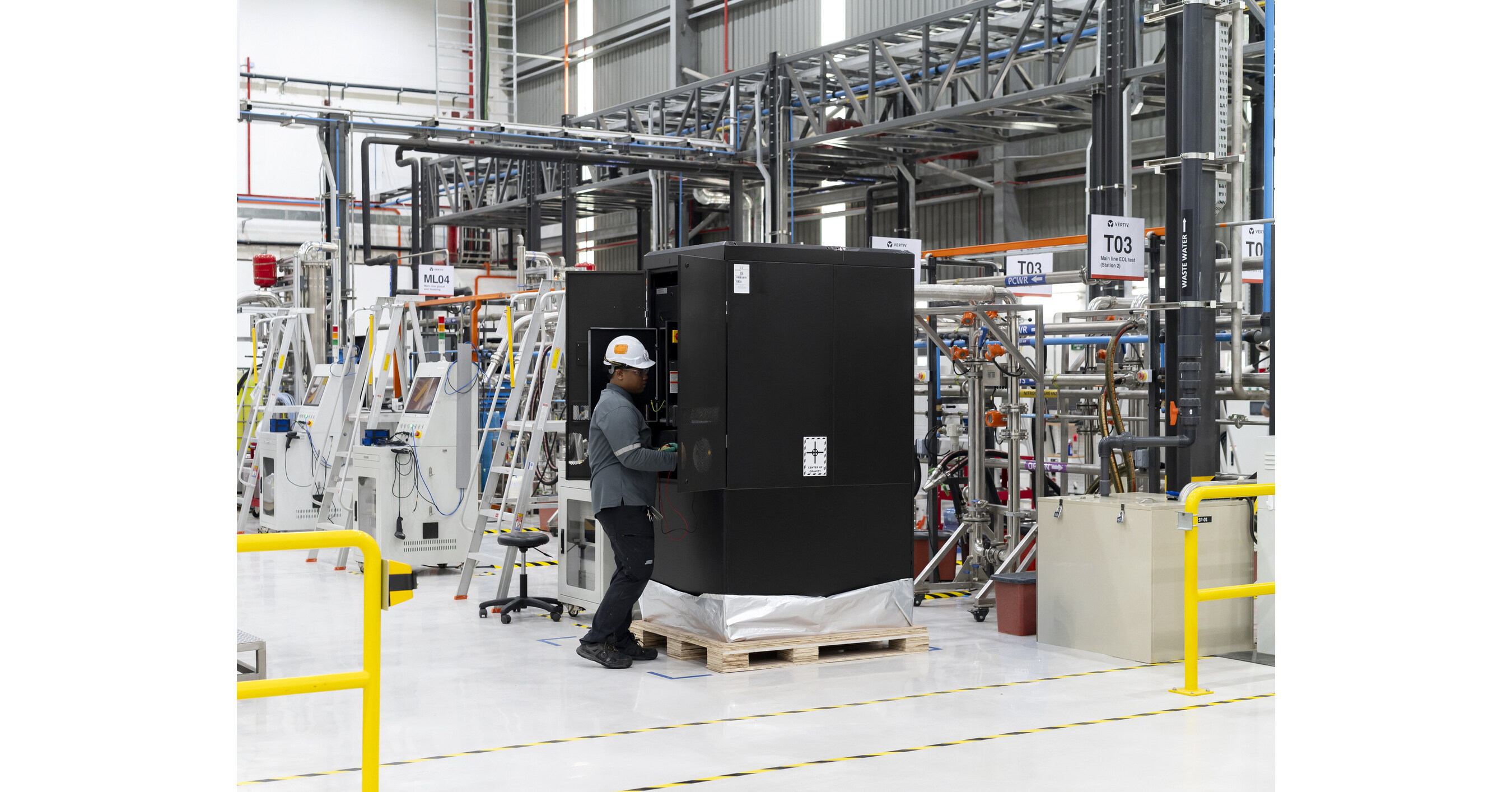
Vertiv (VRT) opened a manufacturing facility in Johor, Malaysia, expanding regional production for AI and high-density computing power/cooling and integrated infrastructure. The site supports end-to-end manufacturing plus witness testing and cites deployment speed improvements of up to 50% for power systems and up to 85% faster for SmartRun overhead infrastructure versus traditional builds. Vertiv expects the facility to add hundreds of skilled jobs by full operationalization in 2027, supporting capacity planning for Asia’s AI/digital infrastructure investment.
This is more a distribution-and-qualification catalyst than a demand catalyst: the value is in converting backlog faster, not in creating new end demand. For VRT, a localized Asia footprint should improve gross margin durability by reducing freight, rework, and commissioning friction, while also lowering the risk of project slippage when customers are racing to energize AI racks. The second-order beneficiary is the hyperscale/colo buildout ecosystem in Asia, where faster deployment can pull forward orders for liquid cooling, modular power, and white-space fit-out across multiple vendors.
The competitive implication is that VRT is trying to defend share against slower-moving incumbents and regional integrators that cannot offer end-to-end test/assemble/ship close to the customer. That matters most in the next 1-3 quarters if lead times remain a gating factor; whoever can deliver validated systems fastest wins the next tranche of capacity. The loser is any vendor selling commoditized power or cooling hardware without local engineering support, because the attach rate on services and integration should migrate toward the supplier that can reduce site-risk, not just quote the lowest sticker price.
The contrarian view is that the market may overread this as a step-change in revenue, when it is really a capital allocation decision with delayed P&L payoff. The facility likely helps more in 2027 than in the next earnings print, so near-term upside depends on whether management can show measurable Asia backlog acceleration, better mix, and improved conversion rather than just ribbon-cutting optics. Falsifiers are simple: if Asia orders slow, utilization at the new site ramps sluggishly, or VRT’s gross margin fails to expand despite the added capacity, the thesis weakens quickly.
AI-powered research, real-time alerts, and portfolio analytics for institutional investors.
Request DemoOverall Sentiment
mildly positive
Sentiment Score
0.25
Ticker Sentiment
