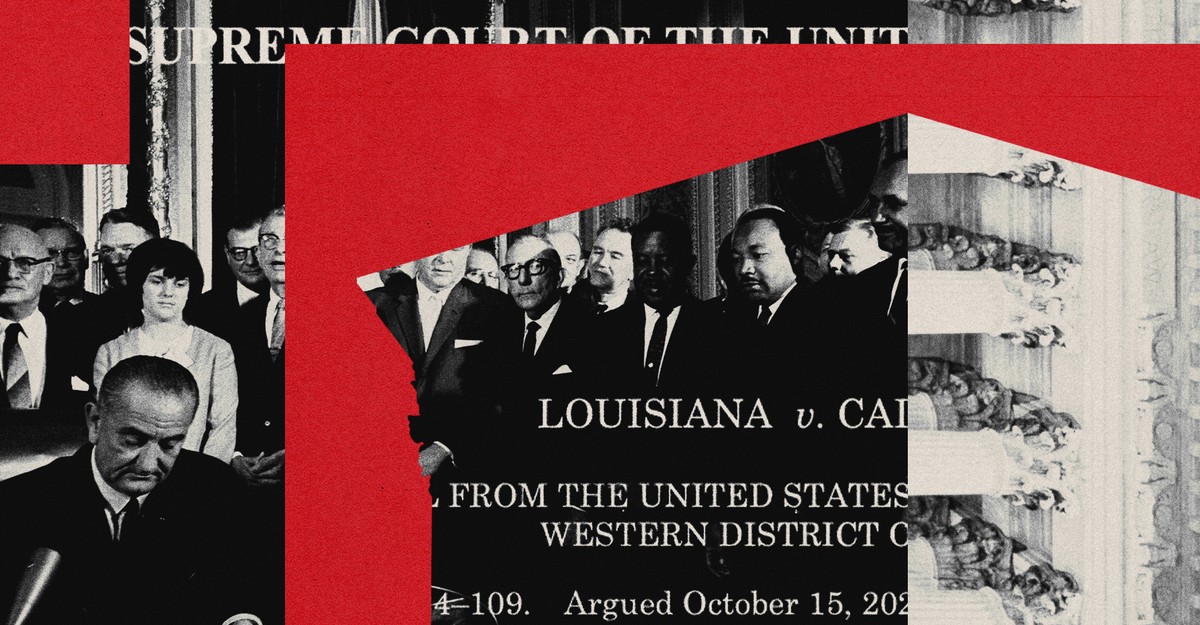
The Supreme Court’s Louisiana v. Callais decision sharply restricts the use of race in redistricting and makes Section 2 Voting Rights Act challenges far harder to win. The article argues the ruling effectively dismantles key VRA protections, likely enabling Republican-led states to redraw maps and eliminate majority-Black districts in coming election cycles. The immediate implications are legal and political, but the ruling is portrayed as a major structural shock to U.S. voting rights and representation.
The market implication is not a clean “risk-off” event; it is a regional power-consolidation shock that should steepen the gap between national political narrative and state-level cash flows. The immediate winners are state Republican machines and incumbents with low-turnout, high-funding districts, while the losers are organizations that monetize turnout expansion: local voter-registration/field operators, civic-tech vendors, and media businesses with heavy Black audience exposure in contested Southern metros. The second-order effect is that political competition in affected states becomes less cyclical and more path-dependent, which reduces the odds of near-term policy swing and increases the durability of entrenched state-level fiscal agendas.
For markets, the bigger risk is not litigation headlines but administrative follow-through over the next 1-3 quarters. Once maps are redrawn, the effective benchmark for “fair” districts shifts downward, and reversing that baseline requires either a future Court change or federal legislation—both low-probability within a single cycle. That makes this a slow-moving but persistent negative for firms exposed to voting access, election infrastructure, and public-sector grant ecosystems, especially where demand is tied to turnout-driven modernization budgets rather than maintenance spending. A related second-order consequence is higher social friction around primaries and election administration, which can raise operating costs for counties and vendors without expanding budgets.
The contrarian view is that the initial emotional reaction may overstate near-term economic fallout outside politics. There is no direct earnings transmission for most broad sectors, and the hardest hit businesses are likely small-cap, politically adjacent, and illiquid rather than index constituents. The better trade is not to short “America” but to target names and baskets with explicit exposure to voting-rights enforcement, civic engagement tooling, and election-administration spending, while recognizing that any federal legislative response would mainly be a 12-24 month optionality event rather than a near-term catalyst.
AI-powered research, real-time alerts, and portfolio analytics for institutional investors.
Request DemoOverall Sentiment
extremely negative
Sentiment Score
-0.90
