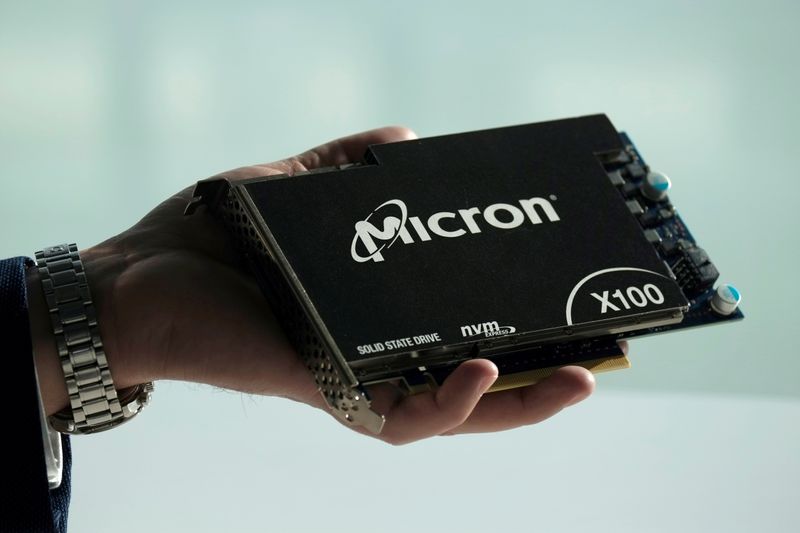
Micron shares rose 4.26% after Seagate issued strong revenue and profit forecasts, reinforcing expectations for sustained AI-driven demand for memory and storage. Morgan Stanley called Seagate "truly firing on all cylinders," while DA Davidson said AI is creating a longer-than-usual memory cycle with structurally higher pricing and demand. The article implies continued enterprise spending on AI infrastructure, which supports Micron’s DRAM and NAND outlook.
The immediate implication is not just a better quarter for storage names; it is a regime shift in bargaining power across the AI hardware stack. When enterprise buyers keep ordering storage into an AI buildout, the margin pool migrates from hyperscaler capex optics to component vendors with tighter supply and longer lead times, which is why the market is re-rating memory as a structural rather than cyclical story. The second-order winner is likely the broader semi-equipment and materials ecosystem, because any sustained pricing strength in DRAM/NAND typically pulls forward tool orders and improves utilization assumptions before it shows up in top-line revisions.
The market is still underappreciating how quickly this can become a sentiment trade as much as a fundamentals trade. Memory names usually move in compressed bursts once investors accept that inventory is not the right lens; that creates upside convexity over the next 1-2 quarters if guidance stays firm, but also sharp air pockets if one large cloud customer pauses orders. The key risk is that AI spend remains concentrated in a few buyers, so a single digestion phase could reverse the narrative even if end-demand is intact.
From a cross-asset perspective, strength in storage should not be read as uniformly bullish for the whole semiconductor complex. It is more favorable for product leaders with visible pricing power than for analog or commoditized chip names that do not benefit from the same demand elasticity. The contrarian point is that the move may be underdone if investors finally price a multi-quarter memory upcycle; however, if consensus has already shifted toward 'long cycle,' the better trade may be to own the highest beta beneficiary and fade the laggards rather than chase the entire basket.
AI-powered research, real-time alerts, and portfolio analytics for institutional investors.
Overall Sentiment
moderately positive
Sentiment Score
0.55
Ticker Sentiment
