
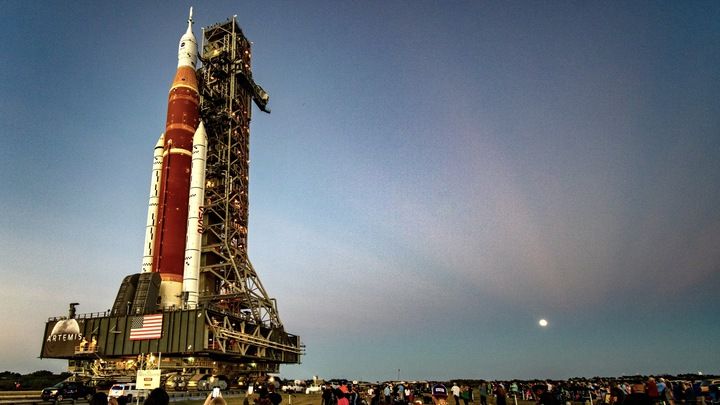
NASA has restructured the Artemis campaign to break complex objectives into incremental missions: Artemis 2 remains a crewed lunar flyby (with a repair-driven launch window opening April 1), Artemis 3 is retargeted for 2027 to demonstrate rendezvous and docking with commercial landers in Earth orbit, and Artemis 4 is planned as the 2028 crewed lunar landing (with a possible second landing on Artemis 5 later that year). The agency is standardizing the SLS Block 1 architecture, de-emphasizing near-term Block 1B/2 upgrades and signaling potential use of a Centaur-like dual‑engine upper stage, while relying on commercial partners (SpaceX Starship, Blue Origin Blue Moon, ULA) and new in-space capabilities (cryogenic propellant transfer) that remain unproven—reducing single-mission risk but leaving schedule and contractor-execution risk for investors to monitor.
Market structure: The NASA pivot lengthens the program roadmap (Artemis 3 in 2027; Artemis 4/5 lunar landings in early/late 2028) and splits high-risk technical milestones across multiple flights. Public beneficiaries are large, diversified contractors (LMT, BA, AJRD, NOC) and ULA-related suppliers if Centaur/ULA work is adopted; private winners include SpaceX/Blue Origin but their value is not investable publicly. Short-term demand for upper-stage hardware, spacesuits and CLPS payloads will rise—potentially 10–30% incremental revenue to select suppliers over 12–36 months if NASA keeps cadence near 1 launch per ~10–12 months.
Risk assessment: Tail risks include Starship failing to demonstrate orbital refueling (probability ~20–40% over 12 months), a Congressional budget shock reducing NASA capex (~10–25% downside to program spend), or a major SLS failure delaying cadence by years. Near-term (days–weeks) volatility will hinge on Artemis 2 repair progress (April 1 window); medium-term (6–18 months) hinge on Starship/Blue Moon tests; long-term (2–5 years) depends on sustained procurement and Congress funding. Hidden dependencies: contractor subcontractor concentration, cryogenic-transfer tech readiness, and export/regulatory constraints on international partners.
Trade implications: Favor large-cap defense/aero suppliers with diversified revenue: establish 1–3% portfolio longs in LMT and AJRD with 9–18 month horizons; use call spreads to cap cost. Pair trade: long LMT (12–18m) vs short/trim small-cap speculative space names (eg LUNR) which lack revenue diversification; expect relative outperformance if NASA standardizes SLS/centaur. Options: buy 9–12m AJRD or LMT call spreads (buy ATM, sell +30–50% OTM) ahead of key milestones (Artemis 2 April window, Starship refuel demo ±6m).
Contrarian angles: Consensus overweights narratives around SpaceX alone solving all risks; that underprices incumbent contractor optionality if NASA adopts Centaur and scales SLS cadence. Market may be underpricing quality suppliers—a successful Artemis 2 + Starship refueling demo could re-rate LMT/AJRD by 15–25% within 12 months. Conversely, the market could be underestimating political funding risk; if Congress trims NASA outyears by >10%, small-cap lunar plays (LUNR) could lose 50%+ value. Historical parallel: Apollo-era cadence required multiple incremental test flights; expect multi-year staggered value realization, not instant winners.
AI-powered research, real-time alerts, and portfolio analytics for institutional investors.
Request TrialOverall Sentiment
neutral
Sentiment Score
0.12
Ticker Sentiment
