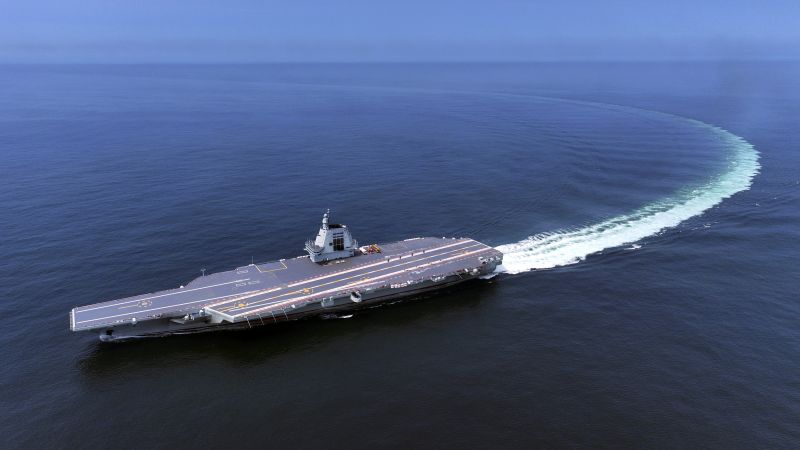
China's most advanced aircraft carrier, the Fujian, has officially entered service, equipped with electromagnetic catapults (EMALS), a technology previously exclusive to the US Navy's USS Gerald R Ford. This commissioning represents a significant advancement in Beijing's rapid naval modernization and its strategic push to narrow the gap with the United States in naval power, despite the Fujian being conventionally powered and potentially less operationally efficient than US nuclear carriers. The development highlights China's increasing military projection and its implications for global geopolitical stability and defense industry investments, with a fourth, potentially nuclear-powered, carrier already under construction.
China has officially commissioned its third and most advanced aircraft carrier, the Fujian, featuring electromagnetic catapults (EMALS) previously exclusive to the US Navy's USS Gerald R Ford. This development marks a significant technological leap for Beijing, personally approved by President Xi Jinping, and underscores China's rapid naval modernization efforts aimed at narrowing the gap with the United States in naval supremacy. The Fujian's entry into service is a source of national pride and a key component of China's strategy to project power and assert territorial claims.
While the Fujian incorporates advanced EMALS technology, enabling heavier aircraft loads and greater strike distances, it remains conventionally powered, necessitating refueling stops unlike nuclear-powered US carriers. US naval experts estimate the Fujian's air operations may achieve only 60% the rate of a 50-year-old US Navy carrier due to flight deck configuration, highlighting a persistent operational gap despite the technological advancements.
The commissioning of the Fujian, along with the ongoing construction of a fourth, potentially nuclear-powered Type 004 carrier, signals China's sustained commitment to expanding its blue-water navy. This aggressive naval build-up, driven by domestic pride and strategic objectives, intensifies geopolitical competition and defense spending trends globally. The low market impact score suggests this event is largely anticipated within defense and geopolitical circles.
AI-powered research, real-time alerts, and portfolio analytics for institutional investors.
Request DemoOverall Sentiment
neutral
Sentiment Score
0.00
