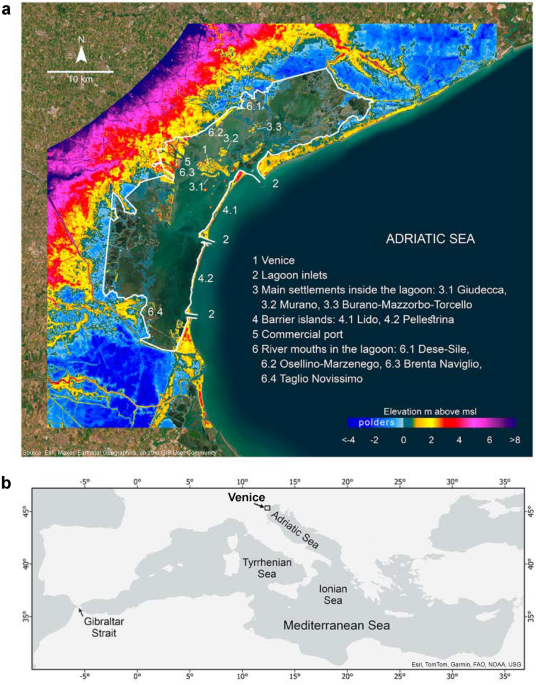
Venice’s current open-lagoon strategy with MoSE barriers is likely to hit functional limits within this century, with adaptation tipping points estimated around 0.75-1.75 m of relative sea-level rise. The paper argues that future options narrow to costly transformational measures such as ring-dikes, a closed lagoon, or ultimately relocation/abandonment under extreme SLR, with large ecological and socio-cultural losses. Indicative costs range from roughly 0.3G€ for ground uplift to 20G€ for permanent lagoon defenses, underscoring material risks for tourism, port operations and heritage preservation.
The investable signal is not “Venice is sinking,” but that the protection stack is transitioning from capex-light, operating-risk heavy to capex-heavy, politically constrained infrastructure with rising failure optionality. That matters because once barrier closures become routine, the system stops behaving like a binary flood-defense asset and starts behaving like a high-opex utility with material downtime costs, ecosystem penalties, and escalating maintenance intensity. In other words, the economic burden compounds nonlinearly before the physical limit is hit, which is where consensus tends to underprice the problem.
Second-order winners are not the obvious civil-engineering primes alone, but firms with exposure to pumps, water treatment, geotechnical work, monitoring, and hard infrastructure retrofit. The hidden loser is the local urban-services stack: logistics, tourism-dependent hospitality, and real estate liquidity all face a slow-burn repricing as adaptation pathways imply either physical fragmentation of the city or an eventual loss of the lagoon’s current operating model. That creates a multi-year drag rather than an acute shock, but with a sharp convexity around major policy decisions and procurement awards.
The contrarian point is that the market may be too focused on peak flood headlines and not enough on lead times. The real catalyst window is 12-36 months: funding approvals, design mandates, and procurement for follow-on systems will need to start well before the current defense architecture becomes inadequate. If mitigation policy or engineering innovation meaningfully slows relative sea-level rise, the most extreme scenarios get pushed out; absent that, the path dependence makes adaptation budgets sticky and increasingly unavoidable.
For broader coastal markets, Venice is a template: once one iconic, well-funded city signals that incremental defenses have hard limits, other low-lying municipalities will be forced into accelerated planning. That should support a multi-year rerating of resilient infrastructure and climate-adaptation vendors while pressuring assets whose cash flows depend on fixed-location, flood-exposed activity. The opportunity is to own the picks-and-shovels of adaptation and fade the exposed real-estate/visitor-economy cash flows that sit at the end of the adaptation chain.
AI-powered research, real-time alerts, and portfolio analytics for institutional investors.
Request DemoOverall Sentiment
moderately negative
Sentiment Score
-0.35
