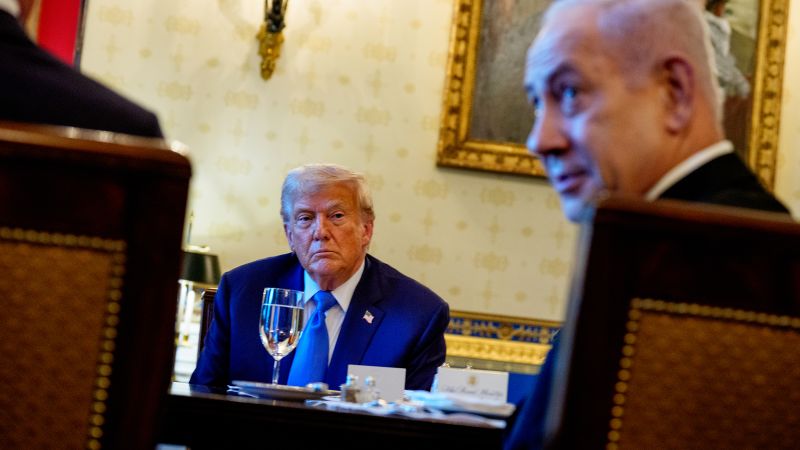
President Trump expressed surprise and displeasure over recent Israeli military actions, including a strike on a Catholic Church in Gaza and airstrikes in Damascus, prompting calls to Prime Minister Netanyahu to 'rectify' the situations and signaling an increasingly tense dynamic between the leaders. Despite high-level engagement and Trump's expectations, Netanyahu's recent Washington visit concluded without a Gaza ceasefire agreement, with Hamas still reviewing the latest proposal. This highlights persistent challenges in US efforts to mediate the conflict and manage allied military operations, contributing to ongoing regional instability and humanitarian concerns.
Recent events indicate a significant and growing friction between the Trump administration and the Netanyahu government, despite their strategic alliance. President Trump's surprise and direct intervention following Israeli military actions in Gaza and Syria, specifically the strike on a Catholic church and airstrikes in Damascus, underscore a divergence in operational and strategic priorities. The White House's public admission that the President was 'caught off guard' and had to 'rectify' these situations with Prime Minister Netanyahu suggests a breakdown in communication or a deliberate lack of coordination by Israel. This tension is further evidenced by the failure to secure a Gaza ceasefire agreement during Netanyahu's recent visit to Washington, a key objective for Trump that went unfulfilled. While the US administration publicly touts its efforts in facilitating humanitarian aid and seeking peace, the ongoing conflict, stalled negotiations awaiting a Hamas response, and condemnation from other Western allies over aid restrictions highlight the limited effectiveness of current US influence and the complexity of the security landscape. The situation points to a period of heightened geopolitical uncertainty, where key allied interests are not fully aligned, potentially complicating de-escalation efforts in the region.
AI-powered research, real-time alerts, and portfolio analytics for institutional investors.
Request DemoOverall Sentiment
moderately negative
Sentiment Score
-0.50
